Thx for the info. I am planning a 1.5 inch cylinder. Did you drive/wheel your Bronco without it or have you always had it? Just wondering your thoughts on the with and without. Love to any pics of your setup. Ideally I will be able to figure out axle tube to tie rod.Couple other guidelines that others can comment on as well:
-Try to keep geometry as inline as possible
-Bigger rams are supposed to be more twitchy steering wise
-Seems to be two schools of thought on attaching it to tie or pitman arm. I dont’t know what pro’s and con’s of those are
Mine goes from axle tube to tie rod







Community
Buy / Sell



Bronco Tech
Fuel Tank Access Plate
3 Arm Wiper Setup
Fix Motor Mount
Roll Cage Braces
Throttle Body 65mm
Wheel Alignment
Heat Riser Replacement
Vent Window Repair
Center Console Mount
Straighten Bumper
Ford 6R80 6 spd
More Tech...
3 Arm Wiper Setup
Fix Motor Mount
Roll Cage Braces
Throttle Body 65mm
Wheel Alignment
Heat Riser Replacement
Vent Window Repair
Center Console Mount
Straighten Bumper
Ford 6R80 6 spd
More Tech...

-
Welcome to ClassicBroncos! - You are currently viewing the forums as a GUEST. To take advantage of all the site features, please take a moment to register. It's fast, simple and absolutely free. So please join our community today!If you have problems registering or can't log into your account, please contact Admin.
You are using an out of date browser. It may not display this or other websites correctly.
You should upgrade or use an alternative browser.
You should upgrade or use an alternative browser.
Ram assist..
- Thread starter Kalex
- Start date
That is awesome! Very clean and low profile.Here are some pics of the clamp I made for my setup, noting it hasn't been fully welded in the mock-up image. I modeled this after one my brother and I made for his Toyota back in the day, and he's never had it slip axially or radially on the tie-rod, but as a clamp, it allows for full range of toe adjustment, unlike a tab welded directly to the tie-rod.

ntsqd
heratic car camper
No experience, but what I've read and observed others to experience is the larger the bore on the ram the more GPM you need out of the PS pump or it will slow down the steering turn rate. With that in mind I'd be looking at a Ø1.25" and possibly smaller (although I've been cautioned against that for reasons that I don't recall).
A friend put one on his desert race truck. Not because he needed a ram to help with the steering, but because they are the best steering damper you can get. Being a Paraplegic he can only steer with one hand (the other runs the throttle/brake), so the best steering damper that he can get is almost good enough.
A friend put one on his desert race truck. Not because he needed a ram to help with the steering, but because they are the best steering damper you can get. Being a Paraplegic he can only steer with one hand (the other runs the throttle/brake), so the best steering damper that he can get is almost good enough.
Double shear done correctly, which I have NEVER seen done on an off-road vehicle and only rarely on a road racing vehicle, is a complicated construction. Yet somehow it became a mantra on forums. I'm good with single shear that is well done, and even better when an "SCCA Washer"* is used on single shear.
I have tried to use one of the tie-rod clamps on the Wagon and it won't clear the drag-link. Were I to put it on the drag-link it solves nothing because it won't clear the tie-rod. I'm likely going to end up building something like this, only the clamp part will be as thin walled as the welded-on stop sleaves:
Then all the clamp does is keep the tabs from rotating instead of also needing to resist any translation force from the damper or a ram. Those sleeves are 'baloney cut' so that the welds don't create a perpendicular stress riser in the tie-rod tube.
*An "SCCA Washer" is called that because of an SCCA rule that single shear attachments of rod ends must have a large, thick washer placed on the out-board side of the SRE. The OD of this washer must be large enough to contain the body of the SRE if the the SRE should fail. The point of the washer is to keep a terribly worn or damaged SRE from being able to abandon ship on it's own.
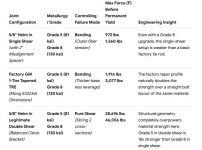
Hi, @ntsqd Not 100% sure what you mean. Bolted connections with lateral loads are generically named "shear connections" in the automotive community. Engineers and Structural guys know that a bolted connection with a lateral load must be analyzed in compound stress. So it gets confusing a bit. The typical tie rod end with a 7 degree taper fails in bending, and has fairly low shear stress. The typical SRE with a misalignment spacer also fails in bending first. Interesting thing about the misalignment spacer is the reduction in bolt diameter. So a typical 1-ton TRE gets replaced with a 3/4 thru hole, but then bushed down to a 5/8 diameter bolt. I let AI do the math for me to show the load carrying capability of the three types of connections.
Your shear connection is superior, because you enable misalignment in the actual boss, so you don't have to de-rate your fastener.
I'm looking at the tie rod connection from @Yeller , and I see a legit double shear configuration. Am I missing something? I'm not fond of his welding to the tie rod, but it's a non-rotating rod. I used a similar configuration except I clamp it in place. My tie rod is also hollow.
As far as cylinder diameter, you don't want to go much smaller bore, with that 5/8 rod. You already get like 17% differential pulling vs pushing. If you had a 1 inch cylinder, it would become un-driveable.
Attachments

Last edited:

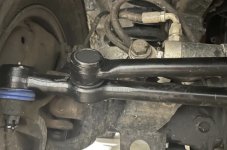
@jamesroney you are correct, nice double shear on the tie rod side. The fixed side is single shear, closer pic. On the bronco all of the connections are single shear, including the tie rod, albeit with a safety washer. The pics are a little fuzzy but I think they are clear enough.
Smarter folks tend to hang out here so the single shear debate really isn’t a debate. But times it has I point out TRE’s, their trailer ball, semi trailer kingpins, even hub spindles are all single shear and listen to the stuttering as they respond lol.
Smarter folks tend to hang out here so the single shear debate really isn’t a debate. But times it has I point out TRE’s, their trailer ball, semi trailer kingpins, even hub spindles are all single shear and listen to the stuttering as they respond lol.
Attachments

Last edited:
Yeah, those connections are called single "shear", but they are actually not shear connections. They are loaded in bending. When engineers analyze the actual connection, we can't just assume a shear joint and call it good. Mohr's circle of stress comes into play, and the bending failure happens at much lower forces.@jamesroney you are correct, nice double shear on the tie rod side. The fixed side is single shear, closer pic. On the bronco all of the connections are single shear, including the tie rod, albeit with a safety washer. The pics are a little fuzzy but I think they are clear enough
Shear calculations are pretty easy, and are just force per cross sectional area. (Tau = P/A) But as soon as you move the load away from the face of either plate...bending stresses dominate. Double shear is more slightly more forgiving, but even then...they are often built incorrectly so as to induce bending loads. I THINK that's what @ntsqd is getting at.
ntsqd
heratic car camper
Double shear, as used with Spherical Rod Ends and Spherical Bearings. Nothing to do with Tie Rod Ends, they're not part of the discussion. Most do a double shear mount with two flat tabs that have to flex to either close the gap needed for assembly or to create the gap needed for disassembly. It works well enough that no one ever bothers with how it should be done, but it does work those welds in the direction that should be avoided if possible. Fortunately that doesn't happen very often so it becomes a non issue or nearly so. Unless you're anal about design for service life like I tend to be.
Ideally high misalignment spacers would have a much larger bearing surface flange on them than they do. As they are they tend to slowly eat into the tab(s) they're captured by unless rigorously checked for installed torque. Were the flange larger then the bending loading in a single tab mount would result in a mostly tensile loading of the bolt (assuming a rigid enough tab). As they are there is some tensile loading compounding the larger bending loading.
Well done double shear looks like this ancient jpg:

The purple/magenta parts are rigid, even can be boxed together if there's reason to. The blue cylinder is a locational slip-fit in the purple boss.
You've seen this exact thing before on alternators with two mounting ears. The rear ear has a part equal to the blue part. Usually it's made like a large roll pin, and it has to be driven back and forth - it won't fall out on it's own.
Ideally high misalignment spacers would have a much larger bearing surface flange on them than they do. As they are they tend to slowly eat into the tab(s) they're captured by unless rigorously checked for installed torque. Were the flange larger then the bending loading in a single tab mount would result in a mostly tensile loading of the bolt (assuming a rigid enough tab). As they are there is some tensile loading compounding the larger bending loading.
Well done double shear looks like this ancient jpg:
The purple/magenta parts are rigid, even can be boxed together if there's reason to. The blue cylinder is a locational slip-fit in the purple boss.
You've seen this exact thing before on alternators with two mounting ears. The rear ear has a part equal to the blue part. Usually it's made like a large roll pin, and it has to be driven back and forth - it won't fall out on it's own.
I love how deep these discussions go into the real engineering of design. I suck at the math and terminology mostly because of my lack of studying it, but do understand the theoretical part and enjoy seeing what is in my head proven or on occasion, disproven, by smart, educated and practiced minds.
It’s truly incredible the knowledge and willingness to help/understand this group provides. Thanks to all.
My pump will be 1,650 PSI with a 3 GPM flow rate. Still undecided as lots of measuring, testing, procurement to go, but intend to use the Lee’s clamp/ hardware on the tie rod end. Hoping to be able to use 2 radiused link tabs welded to the axle near the trac bar mount for the stationary barrel end of the ram. None of this may work, but that’s my initial plan.
My pump will be 1,650 PSI with a 3 GPM flow rate. Still undecided as lots of measuring, testing, procurement to go, but intend to use the Lee’s clamp/ hardware on the tie rod end. Hoping to be able to use 2 radiused link tabs welded to the axle near the trac bar mount for the stationary barrel end of the ram. None of this may work, but that’s my initial plan.
I love it too and rarely if ever have a clue what the exact or correct term is for lots of parts or procedures.I love how deep these discussions go into the real engineering of design. I suck at the math and terminology mostly because of my lack of studying it, but do understand the theoretical part and enjoy seeing what is in my head proven or on occasion, disproven, by smart, educated and practiced minds.

X2 what James said...most things fail in bending, not shear. It was one of the first things they emphasized in enginerding school stress analysis classes when we started to study shear stress and failure analysis. As with anything, there are exceptions, but if you design for bending, shear rarely becomes an issue.
As for ram-assist cylinder bore size, I went around and around on that as well, but if you look at most of the EB houses, talk to PSC and West Texas Off-Road, etc, they're mostly Ø1.5" to Ø2" rams. I chose the Ø2" for my application since I'm running Ø37's and prefer less force differential (~10%) between steering left and right due to the rod diameter, and I believe I bought it through Wild Horses 4X4 since they were the most helpful on the phone at the time. Your pump setup is way better than mine, so that's probably the next thing I'll need to address on my build.
As for ram-assist cylinder bore size, I went around and around on that as well, but if you look at most of the EB houses, talk to PSC and West Texas Off-Road, etc, they're mostly Ø1.5" to Ø2" rams. I chose the Ø2" for my application since I'm running Ø37's and prefer less force differential (~10%) between steering left and right due to the rod diameter, and I believe I bought it through Wild Horses 4X4 since they were the most helpful on the phone at the time. Your pump setup is way better than mine, so that's probably the next thing I'll need to address on my build.
ntsqd
heratic car camper
Found this in the folder of past proposals, this one for a member here who was thinking about double shear mounting of a single steering link:

It's funny, when most look at the jpg that I posted above the assumption is that it is a rigid structure with no concern for bending the bolt, but when they look at this jpg that I stole from Barnes 4WD there seems to be a larger concern about bending the bolt:

They're the same thing! It's just that the "fixed" bracket and the force member are reversed. Only here the bolt isn't constrained from bending like it is in the pic above. The rod ends actually enable the bending of the bolt.
Any of you who were educated about designs like this recall the example of bending a tube with and without a tensile member in the center of the tube? A design like this:

When I look at a stack of parts with a tensilely loaded bolt running down thru the middle of it (like in the stolen pic above) I'm reminded of that lecture. Increasing the torque on the bolt has a dramatic effect on the bending strength of the assembly.
It's funny, when most look at the jpg that I posted above the assumption is that it is a rigid structure with no concern for bending the bolt, but when they look at this jpg that I stole from Barnes 4WD there seems to be a larger concern about bending the bolt:
They're the same thing! It's just that the "fixed" bracket and the force member are reversed. Only here the bolt isn't constrained from bending like it is in the pic above. The rod ends actually enable the bending of the bolt.
Any of you who were educated about designs like this recall the example of bending a tube with and without a tensile member in the center of the tube? A design like this:
When I look at a stack of parts with a tensilely loaded bolt running down thru the middle of it (like in the stolen pic above) I'm reminded of that lecture. Increasing the torque on the bolt has a dramatic effect on the bending strength of the assembly.
My experiences with a few questions that have been asked or stated above. I’ve never experienced twitchiness from any combination. I have had the steering respond slower due to the added volume of fluid needed to turn, it is most noticeable at parking lot speeds or say a muddy hill climb when things are happening fast and you have to lift the throttle to idle. It isn’t always about pump volume, there are a lot of small orifaces in the steering box. Of course the larger the bore and longer the stroke of the cylinder the more dramatic that can be. I’ve never felt it was a hindrance or causing a hazard.
Similar threads

City: springfield
Price: $180
- Replies
- 1
- Views
- 1K

City: Hacienda heights
Price: $550
- Replies
- 4
- Views
- 1K
- Locked
- Replies
- 2
- Views
- 1K
- Locked
- Replies
- 1
- Views
- 1K