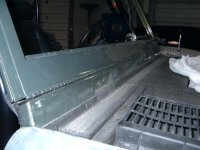
Powers back, so here are some pics. I dont have any pics mid application...simply b/c the adhesive cures fairly quickly. What you cant see...after applying a thick coat to the windshield frame, I used some thin SS washers (which received a coat of adhesive on both sides) between the hinge and frame. The rivets mashed out the excess, which was wiped down with solvent to achieve what you see in the first several pics. The reason for the washers was to maintain a consistent film thickness of the BPA. I was told by the paint rep that film thickness (of 1-4 mil) was necessary to achieve a good bond. He said what I didnt want to do was to use the rivets and then squeezed it all out...so I came up with the thin washers-idea, which he thought was OK.
The frame/hinge application was allowed to cure overnight, then the cowl and hinge were cleaned well with sovent (this is key) and an excess of BPA was applied to the cowl, washers inserted (coated) then the frame/hinge was applied and the rivets installed. Again, excess adhesive was removed and the whole shebang was allowed to cure. Its been strong and no real problems.
The other thing I was told was to scuff the surfaces well with coarse grit prior to applicaton of the adhesive to provide optimal 'tooth'.
The hinge came from JBFab with one set of holes and corresponding cleearance holes. I drilled the other side for mounting, but didnt drill the opposite face to clearance for the heads of the rivets...didnt think it would be necessary in the test fit. After it all cured, I could tell this was a problem...especially with the thick gasket in there. So, I had to come back with a carbide ball to clearance for the cowl's rivet heads (on the frame face)...you can kind of tell in the last pic. Didnt take too long.
The body shop then repainted the adjacent areas while they were repainting some other stuff. Turned out pretty decent.
After a year plus, no problems. I would advise that you use more adhesive than you believe you will need...better to have to clean off the excess than not have enough to fill the entire area.












 Anyways..you need anything, just ask.