23 -My Bronco won't turn over (Won't crank, start, make the Rrrr Rrrr Rrrr sound), but makes a screeching, grinding, clicking, or buzzing noise, or no sound at all, when I try to start it. Why?(This section deals with the engine not turning over at all. When the starter won't turn the engine, not when the engine will turn but not start)
WARNING. Be careful throughout this process.** Sometimes problems can be intermittent, & things will start moving unexpectedly. Some of this testing should cause the engine to turn over & possibly start. Be sure the vehicle can't get away or run over you. Keep it in the correct gear (Park for auto trannies, neutral for manuals), set the brake, block the wheels, keep your hands & wires out of the fan. Disconnect the coil wire to keep the engine from starting at any point (Remember to reconnect once this has been repaired). If you aren't sure, get help or take it to a qualified mechanic.
Is it a grinding/screeching sound, a buzzing/clicking sound, a single click, or no sound at all?
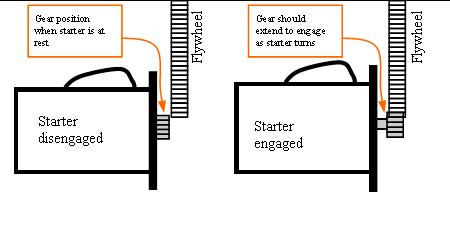
-A grinding sound (Almost screeching) is usually from where the starter engages the flywheel. See drawing "C" below. It can be caused by a loose starter, a starter that's going bad or a bad flywheel. More often than not it's just loose. Check the mounting bolts.
-A buzzing sound, almost like a rapid clicking is usually made by the solenoid on the fender. It's the heavy duty switch that actually turns on the starter. See the pics "D" & "E" below. The key switch turns on the solenoid which turns on the starter. When it is making that noise, there's enough voltage to turn on the solenoid until power reaches the starter, then voltage drops which causes the solenoid to disengage, disconnecting the starter, which raises the voltage enough to turn on the solenoid again & so on & so on. It's the song that never ends. It happens so fast that it sounds like buzzing. Anything in section "A" below could be the cause. Start at Section "B" to narrow down where it might be.
-A single click? The solenoid turns on & stays on, but the starter doesn't/can't turn the engine. See Section "A" below. The testing in Section "B" could help pinpoint the issue.
-No sound at all? Most of the Section "A" below could be the cause. Start at Section "B" to narrow down where it might be.
A- It can click, buzz, or make no sound at all from several causes:
-A weak battery. Not enough juice to crank it once the solenoid closes. Click/Buzz. Measure the voltage at the battery. It should be around 12v. If not charge it & try again. Another possibility is a battery that shows a charge, but won't keep the voltage up under load. A lot of auto parts stores will test them for free with a tester that checks under load.
-Bad cables. Look for swollen places in the insulation, white or green dust/corrosion, worn or burnt places, stiff sections, etc. See pic "E" below. Check all 3 cables (Battery to solenoid, battery to block & frame, solenoid to starter) If you replace them, try to get a larger diameter cable. Stock is typically 4 gauge, changing to a 2 or 0 gauge will pay off in the long run. The stock ground cable connects to both frame & block & it is hard to find a replacement. A good solution is to run a cable from battery to block & then another cable from the same bolt on the block to frame.
-Loose cables. Negative from the battery where it attaches to the engine is a common location, but check them all.
-Dirty cable connections. Don't just clean the outside, clean where the cable contacts the post & where the other end connects too. Especially the ground at the block.
-Cheap clamp on ends. See pic "F" below. Only good for a trail fix to get you to the store to buy a real cable.
-A bad solenoid (Yeah, I said solenoid. Call it a starter relay if you want. I'm old. We've always called it a solenoid, so there. :toothless Solenoid, solenoid solenoid). If you jump across the 2 large solenoid terminals (See the warning above) with a screwdriver or large jumper, it bypasses the solenoid. If it cranks when bypassed, & the solenoid only clicks from the ignition switch, it sounds like a bad solenoid.
-A bad park/neutral safety switch or clutch switch. Testing at the solenoid bypasses these. If it cranks when bypassed at the "S" terminal on the solenoid, look for issues in the circuit that includes the p/n switch (or clutch switch on a manual) & ignition switch.
-A bad ignition switch. Testing at the solenoid also bypasses the ignition switch. If it cranks when bypassed at the "S" terminal on the solenoid, look for issues in the circuit that includes the p/n switch (or clutch switch on a manual) & ignition switch.
-A loose starter that hangs up against the flywheel when it tries to crank. It jams, overloads & drops the voltage.A bad starter. Many auto parts stores will test them.
-A frozen engine. Serious breakage inside, hydrolocked, rusted solid, badly broken parts keeping the engine from rotating, etc. With the key off & the coil wire disconnected, trans in park or neutral, try turning the engine over with a breaker bar on the crank bolt.
If you've had both grinding & buzzing, check the starter mounting bolts, since loose bolts can cause both.
B- Testing at the solenoid
Normally your solenoid should be under the hood, on the passenger side inner fender, near the battery. It should look like the pic below (Well, maybe a little nicer than that one :toothless). It is a good place to start testing.
The solenoid is the final control to supply power to the starter, & where both the small control circuit from the ignition switch & large primary circuit come into play. Older Broncos use the older style, 4 terminal solenoid like the pic "E" below from my 69 F250, Later Broncos have the 3 post type in the pic "D". If you look close in the plastic right above the 2 small terminals on the 4 post, you can see an "S" & an "I".
Be ready to disconnect the battery if it doesn't stop cranking. Do the usual safety stuff. Be ready for the engine to crank throughout testing. Block the wheels, keep it in Park (Neutral for a stick), parking brake set, parked on flat ground, keep wires & hands clear of the fan, etc.**
1- Disconnect everything from the small "S" terminal (the only small terminal on a 3 post) on the solenoid (This should be only 1 wire. If there are more than 1, it can be a source for unintentional cranking). Test the solenoid by momentarily jumping from positive to the small "S" terminal. You jump like you would turn the key to "Start", so you don't do it for very long. It should crank if the solenoid, battery, large cables, & starter are all good, & stop when you disconnect the jumper.
2- If you find that the solenoid is working properly by running that test, measure voltage between the disconnected wire from the "S" terminal & negative. It should read 0 volts at rest, 12v in park with the key switch in the start position. If it reads no voltage with the switch on, you'll have to trace down why it isn't getting power when it should. The ignition switch, P/N safety switch, & the wiring between all affect that circuit.
3- If it doesn't crank jumped to the small "S" terminal, try touching a screwdriver or heavy jumper cable between the 2 large solenoid posts. Again, be ready for it to crank at any time. It may also throw some sparks as you jump across. If it cranks while jumped between the large posts, but doesn't when jumped to the "S" post, it indicates a bad solenoid, or a solenoid that isn't grounded to the fender. Be aware the sometimes new ones out of the box are bad. If it doesn't crank while jumped between large posts, something is wrong in the large circuit that includes the starter, large cables, & the battery. Go thru the list above for possible causes.
C- Starter Engagement
D- 90 Bronco Solenoid (3 post)
E- 69 F250 Solenoid (4 post)
F- Cheesy clamp on end. Do not use for a long term repair. Only to get you home when nothing else is available. If you have one of these, suspect it before anything else.
G- Corroded cable.
From 67 GTO
"Thought I'd add an image for this. Cable was extremely stiff, but not 6" further down. Figure that's an easy way to find 'hidden' corrosion. And, yeah, those universal terminals are complete junk. Guess I'm just a sucker for punishment. :banghead"
** I make sure it is in the correct gear every time. I was taught to, but sometimes it seemed silly to double check. Until I was helping my little brother start his 37 Chevy pickup & suddenly found that it was in compound low, now running, driving over stuff in the yard, with me laying on the fender, going butt first, headed for the fence. I choked the carb to try to stall it, & my brother yanked the coil wire. He said that he thought about it shocking him, so maybe he shouldn't grab it, but then he decided that I might die, so he grabbed it anyway. Thanks again little brother. :thumbup
Online I have seen 3 others with runaway vehicles. One was a remote start added to a manual vehicle in a cold climate. He was sure that it would always be left in neutral. It ended up in a pool. Another was a Bronco that was being started at the solenoid due to ignition issues. At the oil change place he thought they had it in the right gear. He started it for them from under the hood to check for leaks & it drove off the pit & across the street before hitting something. The 3rd drove up into the engine compartment of his wife's car while she was in the driver's seat giving him a jump. She was not impressed.
Bottom line is check the gear every time.