• Welcome to ClassicBroncos! - You are currently viewing the forums as a GUEST. To take advantage of all the site features, please take a moment to register. It's fast, simple and absolutely free. So please join our community today!
    If you have problems registering or can't log into your account, please contact Admin.

Ford trac lok no friction modifier

Timmy390

Contributor
Bronco Guru
Joined
Jan 1, 2011
Messages
5,946
Loc.
Conway, AR
First this in not Bronco but since it's Ford 9 TL related I thought I would post in the tech section for others in this situation.

Long story short, my 1969 Mach 1 BB 390 car has always acted up when cornering. It's not driven that often and I figured it was just an aggressive locker. Well the pinion seal is leaking so I pulled the chunk to see what I had.

It appears to be a Ford TL 4 pin as it should be. I'll post some pics later. I noticed ths gear oil does not stink as in no friction modifier. Lack there of would explan the cornering issues and maybe the strange speed related pulsing vibration it's always had. I thought the vibration was a pinion bearing but they seem fine.

So the question is....these clutches have been in straight gear oil for 20 years. Can I just spray the thing down with brake cleaner and reinstall with gear oil and friction modifier or are the clutches fubar?

Oil was clean and there is very little settlement in the rear housing as in clutch material. I don't want to take this completely apart and do a gear setup unless I really need to. Hoping to replace the pinion seal and swap crush washer with solid spacer and roll if possible.

Tim
 

DirtDonk

Contributor
Bronco Guru
Joined
Nov 3, 2003
Messages
51,616
Agreed. But just how much do you want it to act like a limited slip? Reason I ask is, if you’d rather get rid of the grumbling and groaning around corners, and don’t really care if you get two wheel burnouts every time and blinding acceleration (along with the associated instability around corners), put some full synthetic in there.
Usually it’s so slippery that it does more than a typical friction modifier and actually reduces the effectiveness of it as a limited slip.
So it’s two edged sword. Good and bad…

Also, what gear ratio is it? I guess more specifically, what tooth count between the ring gear and the pinion gear?
Some gears are prone to harmonics. I forget what they’re called. Maybe “hunting” versus “non-hunting“ gear sets?
Doesn’t sound right, but it’s something along those lines.
In those cases, nothing gets rid of the harmonic. So is yours an actual felt vibration? Or is it more of a sensed vibration through sound?
 
OP
OP
Timmy390

Timmy390

Contributor
Bronco Guru
Joined
Jan 1, 2011
Messages
5,946
Loc.
Conway, AR
I would like it to act like a LS should. I considered dropping in a eaton truetrac like I have in the Bronco but this LS and gears look new and I don't have $500 in my pocket right now. It does lock up and spin both wheels. It unloads like a spartan locker around some corners. Bang and pop...

The vibration is felt when crusing. It's a pulsing vibration and is not rpm related. Pulsing gets quicker the faster you go. Been chasing it for years. Trans tailshaft bushing is good, trans mount is good, drive shaft balanced and new U joints. Wheels balanced. No bad wheel bearings. Drum brakes so not warped rotors. Has to be the rear end right? :)

Gear ratio is 3.25. I'll have to count the teeth.

Has what appears to be original axle seals (hard as a rock but not leaking) and original axle bearings. If they're not originals they were replaced with OEM as they have ford stamped on them.

Tim
 

jamesroney

Contributor
Bronco Guru
Joined
Sep 11, 2007
Messages
2,594
Loc.
Fremont, CA
The purpose of friction modifier is to allow slippage without sticking, galling, or chattering. The lubricant, along with the friction modifier actually allows the steel plates to burnish the fibers. Eventually the steels will start to polish the fibers, until they are consumed.
(You already know this…but I need to establish words for descriptions. And I’m using “fiber” generically. I know they aren’t always fibrous.)

When you assemble the clutch pack for the first time…it is critical that the burnishing process is allowed to happen. Some people call this “seasoning” the discs…but I’ve never really understood those physics. I recognize that the fibers are porous, but I’ve always believed that they can be cleaned, polished, and re-installed.

But you really do need to be 100% certain that there is no galling, or imperfections on the steels. Everybody pays attention to the fibers, but it’s the steels that get you.

So there’s no reason why you can’t polish the steels with a D/A, clean the fibers with solvent, season the fibers with the modifier, re-stack them, and allow them to burnish again. This process should take 2 days of elapsed time, but literally 15 minutes of actual labor content. Obviously, no shop can do this cost-effectively…so no one recommends it. Especially when new clutches are available, and the cost is passed to the consumer.

But I’ve had very good success recovering Dana-Spicer clutch packs and I’ve had plenty of long term experience with old clutches that I’ve “harvested” from take outs to use in my stuff.

All that being said…if you have a 1969 4 pinion traction Lok…please check the casting number on the case, and if it hasn’t been upgraded to the D0oW hat…I urge you to get one or buy the billet hat. All of the factory hats are bad, but the 70+ hats are less bad. Less prone to break with an auto trans.

Your 390 Mustang should have come with the 3.062 (big) carrier bearings and 28 spline shafts. Solid spacer is a waste of money. If your vibration is happening at highway speed, it’s not the traction Lok clutches. Look for a cracked hat, or a bent carrier. Measure everything with a dial indicator.
 
Last edited:
OP
OP
Timmy390

Timmy390

Contributor
Bronco Guru
Joined
Jan 1, 2011
Messages
5,946
Loc.
Conway, AR
The purpose of friction modifier is to allow slippage without sticking, galling, or chattering. The lubricant, along with the friction modifier actually allows the steel plates to burnish the fibers. Eventually the steels will start to polish the fibers, until they are consumed.
(You already know this…but I need to establish words for descriptions. And I’m using “fiber” generically. I know they aren’t always fibrous.)

When you assemble the clutch pack for the first time…it is critical that the burnishing process is allowed to happen. Some people call this “seasoning” the discs…but I’ve never really understood those physics. I recognize that the fibers are porous, but I’ve always believed that they can be cleaned, polished, and re-installed.

But you really do need to be 100% certain that there is no galling, or imperfections on the steels. Everybody pays attention to the fibers, but it’s the steels that get you.

So there’s no reason why you can’t polish the steels with a D/A, clean the fibers with solvent, season the fibers with the modifier, re-stack them, and allow them to burnish again. This process should take 2 days of elapsed time, but literally 15 minutes of actual labor content. Obviously, no shop can do this cost-effectively…so no one recommends it. Especially when new clutches are available, and the cost is passed to the consumer.

But I’ve had very good success recovering Dana-Spicer clutch packs and I’ve had plenty of long term experience with old clutches that I’ve “harvested” from take outs to use in my stuff.

All that being said…if you have a 1969 4 pinion traction Lok…please check the casting number on the case, and if it hasn’t been upgraded to the D0oW hat…I urge you to get one or buy the billet hat. All of the factory hats are bad, but the 70+ hats are less bad. Less prone to break with an auto trans.

Your 390 Mustang should have come with the 3.062 (big) carrier bearings and 28 spline shafts. Solid spacer is a waste of money. If your vibration is happening at highway speed, it’s not the traction Lok clutches. Look for a cracked hat, or a bent carrier. Measure everything with a dial indicator.
Pinion 12 teeth, ring gear 39 so 3:25 ratio. 28 spline axles.

Got the pinion assembly out. It does have a "hitch" when spenning it by hand. Bearings are tight as in no movement but clearly something is binding.

Pinion hat is C5AW-4688A
Housing is C7AW-G

So really you're saying to just buy a TL rebuild kit and do it right.

Tim
 

jamesroney

Contributor
Bronco Guru
Joined
Sep 11, 2007
Messages
2,594
Loc.
Fremont, CA
Pinion 12 teeth, ring gear 39 so 3:25 ratio. 28 spline axles.

Got the pinion assembly out. It does have a "hitch" when spenning it by hand. Bearings are tight as in no movement but clearly something is binding.

Pinion hat is C5AW-4688A
Housing is C7AW-G

So really you're saying to just buy a TL rebuild kit and do it right.

Tim
Nope, I’m saying if it were mine, Id go ahead and fix it.

If I were building it for a customer, I’d replace it.

But I think you are going to find something bent, cracked, or out if round.

I’m not looking for the pinion support. That’s not the hat.

I’m looking for the traction Lok left side carrier plate. Google “traction lock billet hat”
 
OP
OP
Timmy390

Timmy390

Contributor
Bronco Guru
Joined
Jan 1, 2011
Messages
5,946
Loc.
Conway, AR
I can't find a casting number on it. Says FoMoCo....4206 with a E all in a different spots. All that's on the ring gear bolt side. Nothing on the other half that I can find. It is cast iron....

Took the pinion apart and removed the old seal. Replaced the crush washer with solid spacer...still had a hitch. New bearings will be here tomorrow

Tim
 

jamesroney

Contributor
Bronco Guru
Joined
Sep 11, 2007
Messages
2,594
Loc.
Fremont, CA
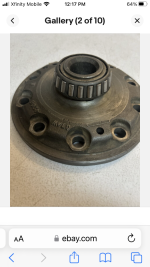
4206 is the root number for a differential carrier. E is the version number. The prefix is important. Likely C7AW-4206-E. Like this one…

It’s cast, and weak. Check for cracks. Then Chuck it up in a lathe and indicate the ring gear flange. Should be dead nuts at zero, or maybe +/- .001.

I’m surprised that your pinion has a hitch in the rotation. But if it does…that is very likely your problem.
 

Attachments

  • IMG_3059.png
    IMG_3059.png
    626.4 KB · Views: 95

ntsqd

heratic car camper
Joined
Jan 30, 2005
Messages
5,953
Loc.
Upper SoKA
FWIW I have "relaxed" two crush spacers, one in a Ford 8" (same p/n as the one used in a 9") and one in a later Toyota 8" Both wiped out the R&P. The Ford 8" wasn't abused, the Toyota 8" was. I don't see solid spacers as a waste, I see them as a necessary thing. My own preference is for a spacer that is longer than needed and hardened. Then I use the surface grinder to slowly sneak up on the desired pinion bearing pre-load.

In two cases I've been involved with 2WD front spindles where we or 'they' did the same thing; a solid spacer between the wheel bearings. In the case of the S10 desert truck adding the bearing spacers significantly stiffened the spindles because now you can put some grunt on that wheel bearing nut and the assembly behaves like it's a much larger OD than just the spindle itself. In a severely abused 9" I would expect the spacer to perform in a similar manner; effectively making the pinion shaft much larger in diameter.
 

bmc69

Contributor
Bronco Guru
Joined
Jun 11, 2004
Messages
12,015
FWIW I have "relaxed" two crush spacers, one in a Ford 8" (same p/n as the one used in a 9") and one in a later Toyota 8" Both wiped out the R&P. The Ford 8" wasn't abused, the Toyota 8" was. I don't see solid spacers as a waste, I see them as a necessary thing. My own preference is for a spacer that is longer than needed and hardened. Then I use the surface grinder to slowly sneak up on the desired pinion bearing pre-load.
I'm right there with ya...no crush spacers in any of the difs I've built.
 

jamesroney

Contributor
Bronco Guru
Joined
Sep 11, 2007
Messages
2,594
Loc.
Fremont, CA
I'm right there with ya...no crush spacers in any of the difs I've built.
And the myth goes on...

@ntsqd let me get this right.
A crush sleeve was installed in every GM 14 bolt, 10 bolt, and 12 bolt since 1964.
A crush sleeve was installed in every Ford 8 inch and 9 inch since 1957.
A crush sleeve has been installed in some Dana 44's since 1985, and in every Dana 44 since about 2008.
A crush sleeve is now found in all Dana axles from the Dana 30 up to the Dana 110.
The AAM axles run a crush sleeve.

So I'm going to say that almost every production live axle sold today, and most of them for the past 60 years uses a crush sleeve for pinion preload. And somehow you have managed to over-crush 2 of them?

Can you please explain the physics? The inner pinion bearing carries 100% of the thrust load driving forward. The outer pinion bearing carries 100% of the thrust load driving in reverse. Once the distance is established between the bearings, (by the NUT) the pinion crush sleeve does nothing. In FACT, the only purpose of the crush sleeve is to keep the nut tight to keep the yoke tight. If you left the crush sleeve on the bench, and properly set the pinion nut location...you could weld the nut in place, (or secure it with a cotter pin!) and the pinon would run like that forever. (until the bearings wore out...) (Interesting that this is how an axle unit bearing works) Your 2WD S10 spindle improvement actually proves the point.

So if the pinion shaft is not bending, and the differential case is not compressing...how are you managing to crush the crush sleeve? You would have to actually overtighten the pinion nut and deform the bearings and even then...the preload would be excessive. The only other way is if the bearings wear out, and you overtighten the pinion nut, and then try to re-use the crush collar.

Don't get me wrong. I am a big fan of select fit solid pinion spacers. Nascar ran them for decades. But only because it allows me to swap gears easily, without wasting a crush collar. And it allows me to over-tighten the pinion nut with an impact wrench.
 
OP
OP
Timmy390

Timmy390

Contributor
Bronco Guru
Joined
Jan 1, 2011
Messages
5,946
Loc.
Conway, AR
I like a solid spacer for ease of setup and the ability to change seals later on with just a quick nut removal.. Seals are not what they used to be.........Seems failures are more and more often these days.

Will have pinion bearings this PM. Just took the old bearing off the pinion (love my HF press). Will knock out the races next. I'm ready to get this "hitch" taken are of and move on the carrier inspection. No lathe in my shop and no access to one so visual is all I can do. Open to suggestions....... Ordered an "oil slinger" as it was missing. Some say run it...some say don't matter....Can always remove it when I change seals again LOL

Tim
 

ntsqd

heratic car camper
Joined
Jan 30, 2005
Messages
5,953
Loc.
Upper SoKA
I've no idea what the physics are, and I've no idea how I managed to further crush two of them in service when those who are supposed to know say it can't be done or isn't easy to do. I do know that I've managed to do it. Twice. I would suggest that perhaps the nut worked loose except that in the case of the Toyota pinion there is a notch in the end of the threads that a thin ring on the pinion nut is staked into once the pre-load is set. It was still staked tightly in place.
That leaves the bending of the pinion shaft (what I think actually happened) or the recession of the bearing race locating shoulder(s) as the likely explanations.

I tease that MISF could break an anvil while playing in a sandbox using only a rubber hammer, but he might not be alone......

What's that law in science about it only takes one exception to disprove a rule that has millions of successful instances? that is how I think of all of those vehicles that work perfectly fine with one.

I do recall in an intro design class where one of the examples in the book was a tube with a tensilely stressed rod was placed in the center of the tube. The example then calculated the bending strength of the tube with and without the rod. Bending resistance significantly improved with the rod. That alone, for me, is enough to warrant using the solid spacer.

Crush washers do have a use, they're great for quickly getting close to the needed solid spacer length. Set the pre-load with the crush spacer, then take it apart and measure the crush spacer. Make the solid spacer that dimension as the starting point. You'll likely need to take a couple thou off of it to get the desired pre-load, but they're a great way to save some time.
 
Last edited:

ntsqd

heratic car camper
Joined
Jan 30, 2005
Messages
5,953
Loc.
Upper SoKA
Crush spacers are a great labor and cost saver for the OEM, and they're helpful in determining what the solid spacer's length should be. I see no other advantage to them.
 

jamesroney

Contributor
Bronco Guru
Joined
Sep 11, 2007
Messages
2,594
Loc.
Fremont, CA
What myth? Fact. Every dif I've built has solid spacers.
The myth that they provide superior bearing preload properties, or provide some functional benefit to the consumer.

Of course I believe you when you say you use them…
 
Top