• Welcome to ClassicBroncos! - You are currently viewing the forums as a GUEST. To take advantage of all the site features, please take a moment to register. It's fast, simple and absolutely free. So please join our community today!
    If you have problems registering or can't log into your account, please contact Admin.

Ford trac lok no friction modifier

jamesroney

Contributor
Bronco Guru
Joined
Sep 11, 2007
Messages
2,594
Loc.
Fremont, CA
Crush spacers are a great labor and cost saver for the OEM, and they're helpful in determining what the solid spacer's length should be. I see no other advantage to them.
No disagreement there. But I still don’t understand how you killed yours.

…And I really do hate them. Much like single use head bolts, and non-serviceable unit bearings, etc.

But this thread started as a “fix it cheap” post. And there’s nothing cheap about a $40 preload spacer, when the original crush sleeve is in your hand.
 
OP
OP
Timmy390

Timmy390

Contributor
Bronco Guru
Joined
Jan 1, 2011
Messages
5,946
Loc.
Conway, AR
No disagreement there. But I still don’t understand how you killed yours.

…And I really do hate them. Much like single use head bolts, and non-serviceable unit bearings, etc.

But this thread started as a “fix it cheap” post. And there’s nothing cheap about a $40 preload spacer, when the original crush sleeve is in your hand.
DITTO on the torque to yield bolts

I picked up the solid spacer with shims for $22.47 delivered. Crush sleeve is around $8 local so yep, I over spent.

I'm in the ditch on the fix it cheap by just adding friction modifier. If the case is in good shape, I'm going to put in new clutches in the TL for sure. Kit with springs is $85 Pinion bearings/races has me on the hook for $55 and then the pinion seal, the O ring that was hard as a rock, oil slinger that was mission, new pinion nut, new ring gear bolts (cause everyone says to not reuse) , gear oil, friction modifier and shop supplies....and I'm sure more stuff will pop up.

Still cheaper than buying a whole new 3'rd...So there is that.

Tim
 
OP
OP
Timmy390

Timmy390

Contributor
Bronco Guru
Joined
Jan 1, 2011
Messages
5,946
Loc.
Conway, AR
So I found the inner and outer bearing and race was the same on this pinion. Timken M88048 "made in USA" stamped on them. All the local parts stores show different part numbers for inner and outer bearing. Races are the same P/N.

Inner bearing is double the price as the outer? Marketing or was the wrong inner pinion bearing used on this pinion? Parts store shows, Inner = HM89443 Outer = M88048

Tim
 

jamesroney

Contributor
Bronco Guru
Joined
Sep 11, 2007
Messages
2,594
Loc.
Fremont, CA
Pinion hat is C5AW-4688A
Housing is C7AW-G

Tim
The C5AW-4668-A (I've never heard of a "4688" so I'm assuming "4668" is the correct pinion support for your 3.062 case C7AW-4025-G.

Many books think that the S-code got the "heavy duty, big bearing" carrier, so they assume that means the big pinion bearing as found in the Nodular housings. But as you can see, the "big block" 390 did not get the "big block" rear end.

As it happens, the 390 did not get the "big block" toploader either. (It got the small block toploader with a shorter 390 input shaft, and Fairlane 28sp tailhousing)

The 89443 is for the Daytona Support, which is the C5AW-4668-C pinion support. That bearing is indeed double the cost.

Your pinion support uses a pair of 88048's. (and so does my S-code Mustang...)

It's worth pointing out that the 428, and Boss 302 got the Performance "Heavy Duty" housing, with the "heavy duty" carrier bearings, and the "heavy duty" pinion, and the "heavy duty" shafts. (C4AW-B Nodular, 3.062 bearings, C5AW-C Daytona support, 31 spline shafts)
The 390 only got the heavy duty carrier bearings, which needed the heavy duty housing, but not the special performance housing, so it got the C7AW-G housing. Small blocks got the C7AW-E (2.891) case. In a fit of confusing insanity, Ford decided to build a heavy duty non-performance Nodular case for ambulance service. That is the D0OW-B "N" case with 2.891 bearings.

Most parts books do not keep up, and list some / both / all. It's very painful, because people drop off a bucket of parts, and get mad when I make them go get more parts. On the bright side...I end up with a lot of free left-over bearings.

 
Last edited:
OP
OP
Timmy390

Timmy390

Contributor
Bronco Guru
Joined
Jan 1, 2011
Messages
5,946
Loc.
Conway, AR
The C5AW-4668-A (I've never heard of a "4688" so I'm assuming "4668" is the correct pinion support for your 3.062 case C7AW-4025-G.

Many books think that the S-code got the "heavy duty, big bearing" carrier, so they assume that means the big pinion bearing as found in the Nodular housings. But as you can see, the "big block" 390 did not get the "big block" rear end.

As it happens, the 390 did not get the "big block" toploader either. (It got the small block toploader with a shorter 390 input shaft, and Fairlane 28sp tailhousing)

The 89443 is for the Daytona Support, which is the C5AW-4668-C pinion support. That bearing is indeed double the cost.

Your pinion support uses a pair of 88048's. (and so does my S-code Mustang...)
Wealth of knowledge you are Sir.

Had some younger eyes look at the casting number on the pinion support. You are correct..... 4 6 6 8 A Those 6's look like 8's to me unless I get it in the perfect light. Might be time to get thicker glasses. :) That saves me $13.99 plus tax.....and I say Thank You for that......

Tim
 

ntsqd

heratic car camper
Joined
Jan 30, 2005
Messages
5,953
Loc.
Upper SoKA
No disagreement there. But I still don’t understand how you killed yours.

…And I really do hate them. Much like single use head bolts, and non-serviceable unit bearings, etc.

But this thread started as a “fix it cheap” post. And there’s nothing cheap about a $40 preload spacer, when the original crush sleeve is in your hand.
I don't know either. My local gear set-up guy has seen it happen before, but I'm the first that he knew of to have it happen to twice, in different vehicles. Rather than worrying about it I just moved on. Earlier yota 8"s came with solid spacers, so a call to Marlin (RIP) had that diff squared away. Even way back then I think the shipping cost more than the part.

I've made these spacers before, they're not a difficult lathe project if that is an option. Make them from a decent steel alloy (HSLA, 4130, etc.) and then some Kasenit to case harden them has been good enough. Of the 7 Otto Vu diffs we rebuilt one summer I think we had to make one or two such spacers. For some reason early 50's era Fiat parts aren't common. LOL

yeah, torque to yield head bolts, what were they thinking? Job security for ARP anyway.......
 

Yeller

Contributor
Bronco Guru
Joined
Mar 27, 2012
Messages
7,688
Loc.
Rogers County Oklahoma
I too have had crush sleeve failures. I always do solid spacers as well, although I will admit to building a few 14 bolts when I didn’t have ready access to a lathe, the can say they are the hardest to crush I’ve ever dealt with, soooo glad the pinion can be put in a press. Tighten the nut, place in 20 ton press, squeeze until it is crying uncle, tighten the nut, repeat until you have the right preload, even at that I’ve repaired them because they crushed further.

Today a solid spacer can be bought for about anything.
 

jamesroney

Contributor
Bronco Guru
Joined
Sep 11, 2007
Messages
2,594
Loc.
Fremont, CA
I too have had crush sleeve failures. I always do solid spacers as well, although I will admit to building a few 14 bolts when I didn’t have ready access to a lathe, the can say they are the hardest to crush I’ve ever dealt with, soooo glad the pinion can be put in a press. Tighten the nut, place in 20 ton press, squeeze until it is crying uncle, tighten the nut, repeat until you have the right preload, even at that I’ve repaired them because they crushed further.

Today a solid spacer can be bought for about anything.
...but you can't explain how and why the crush sleeve, which is constrained between two giant tapered roller bearings, in a solid cast iron pinion support ends up getting over-crushed and failing.

I also find the 14 bolt to be a little stubborn, and yeah...the press is my best friend. But it still doesn't tell me how an otherwise properly set up pinion crush collar manages to find itself failed. And if it were just a million of successful crush sleeves, I might think it's normal. But we are talking about a million crush sleeves installed per WEEK. Every week. For 50 years.

Please bear in mind that for 30 years, I put in a solid sleeve, every time. For a while, I had a bunch of Nascar take out sleeves, and select fit solid sleeves. And I would machine my own sleeves. But about 15 years ago, about the time when Dana put a crush collar in the 44 and you had to order the right gear set...I started asking Why?

Since then, I've been looking for crush sleeve "failures." In EVERY case, there was either an improper installation, or human intervention in the form of tampering. In all of the outliers that I observed, there was a leak, a loose bearing, and subsequent "tightening" by the user to take up the slack. I came to realize that a failed crush sleeve is not normal. And cannot be explained by statistics. As a Six Sigma Black Belt, I cannot reconcile the failure mode. I'm hoping that someone can set me straight.
 

ntsqd

heratic car camper
Joined
Jan 30, 2005
Messages
5,953
Loc.
Upper SoKA
What are the possible modes that would lead to a crush sleeve becoming more compressed? These are what I can think of off the bottom of my head:
Nut loosens.
Pinion shaft bends.
Housing flexes.
Bearing bore shoulders recede.

I happen to have unintentionally listed them in what I think is the likely probability of occurrence.

Nut loosening is pretty normal thing to have happen. They shouldn't but they do. It happens. Might have been the cause of my Ford 8"s failure, been far too long ago to recall. Was not the cause of the yota 8" failure.

Shaft bending, well some of us have seen drag race 9" housings where the fill plug has been re-purposed as a stop to prevent ring gear deflection. If we can elastically deform the ring gear and it's carrier then the pinion shaft has no hope of not bending. Even witho a deflection stop some of that force is bending the pinion shaft. Those gears are badly wanting to get away from each other.

With the kinds of loads that can deflect the ring gear and it's carrier it's not unreasonable to think that the housing could be elastically deformed as well. They are usually iron, so they're on the stiff side and not normally thought of "elastic", but in the interest of unsprung weight and economy of production they do tend to be rather thing walled. They're only thick where they need to be and not much of anywhere else. They aren't going to distort very much before they crack, but it wouldn't take much to compress the crush spacer enough for it to be loose.

For the bore shoulders to recede means that the housing casting is either been worn away or is compressible. I can see either being possible, but highly unlikely. The thrust load on those shoulder s could be quite high, but I'm not convinced that this is the likely mechanism when there are far more likely means.
 
OP
OP
Timmy390

Timmy390

Contributor
Bronco Guru
Joined
Jan 1, 2011
Messages
5,946
Loc.
Conway, AR
Well I'm no expert but I think the pinion support is warped. First indication was the new races didn't set flush. I drove them home and started playing with preload. Started where I was with the crush washer and that gave me 10 inch pounds but here's the thing.....

When spinning the pinion at positions 3 o'clock and 9 o'clock the beam torque wrench starts bouncing and resistance goes to 20 inch pounds. You can feel the bump bump bump bump. It's smooth in the rotation but for those 2 positions. I'm using the torque wrench handle to note the positions.

Kind of scratching my head. I've built a couple 9's as well as some Suzuki thirds, a dana 44, even a couple chevy bearing changes and not seen anything like this.

Thoughts?

Tim
 
Last edited:

jamesroney

Contributor
Bronco Guru
Joined
Sep 11, 2007
Messages
2,594
Loc.
Fremont, CA
Well I'm no expert but I think the pinion support is warped. First indication was the new races didn't set flush. I drove them home and started playing with preload. Started where I was with the crush washer and that gave me 10 inch pounds but here's the thing.....

When spinning the pinion at positions 3 o'clock and 9 o'clock the beam torque wrench starts bouncing and resistance goes to 20 inch pounds. You can feel the bump bump bump bump. It's smooth in the rotation but for those 2 positions. I'm using the torque wrench handle to note the positions.

Kind of scratching my head. I've built a couple 9's as well as some Suzuki thirds, a dana 44, even a couple chevy bearing changes and not seen anything like this.

Thoughts?

Tim
ok, take the crush collar out and do your diagnosis with it on the workbench.

How does the pinion feel on just the inner bearing? Is the pinion bent?

If you have some dyechem, you can paint the races and look for the contact pattern. I’ve used a black Sharpie in a pinch.

Hard to believe that the pinion support bores are out. But it’s possible.
 

Yeller

Contributor
Bronco Guru
Joined
Mar 27, 2012
Messages
7,688
Loc.
Rogers County Oklahoma
@jamesroney no I have no explanation either. For, gotta race tomorrow… and I’m out of bearings I’ve thrown in a spacer and it work fine, but I’ve also seen oddly worn bearings. On 9” I think the pinion gets stretched, I’ve broken plenty of them. But the 14 bolt, I have no idea.

As for the Daytona pinion support I’m curious of others experience. In a Bronco or similar application, heavy, 4.88-5.13 gear 35’s with OD trans and a lot of interstate driving, I’ve seen many failed pinion bearings at the pinion. My thoughts are that the bearing isn’t up to the rpm and pressure developed. Same drivers, same vehicle, same habits, go from an annual issue to never again once gone to a Daytona support. I know when I went to them and solid spacers I stopped getting complaints. From what I have read that support was developed for NASCAR because at 200 mph they were having pinion bearing failures, I just associate the failures being related, deep gearing with high speed and high loads.

Once I started putting Daytona supports and solid spacers in every build the complaints stopped. Now I have built very few stock cases, the vast majority of mine have been with modern high strength cases. In most of the builds I have tracked, stock cases often resulted in broken gears or broken cases, it’s a bad day watching a pinion shaft roll down the hill…. LOL.

At one point I was building 2-3 brand new 9’s with 4.88’s a week, never had a warranty, only ones I saw fail had broken pinions, moved those special fellas to a 35 spline pro gear and never looked back.

I have seen the same issue that @Timmy390 is describing. Never dug into the cause.
 

bmc69

Contributor
Bronco Guru
Joined
Jun 11, 2004
Messages
12,015
The myth that they provide superior bearing preload properties, or provide some functional benefit to the consumer.

Of course I believe you when you say you use them…
Peace of mind when confronted with changing out a busted yoke on the trail or back at our pit area...or replacing a damaged pinion seal... ;-) No torque wrench....impact gun and git er done.
 
OP
OP
Timmy390

Timmy390

Contributor
Bronco Guru
Joined
Jan 1, 2011
Messages
5,946
Loc.
Conway, AR
ok, take the crush collar out and do your diagnosis with it on the workbench.

How does the pinion feel on just the inner bearing? Is the pinion bent?

If you have some dyechem, you can paint the races and look for the contact pattern. I’ve used a black Sharpie in a pinch.

Hard to believe that the pinion support bores are out. But it’s possible.
Got up early and took the solid spacer out. Brought turning resistance to 15 inch pounds.......still has the 2 spots that bump bump bump. Beam indicator bounces like going over a washboard on a dirt road. Crazy.....spins smooth till you get around the 10 inch pound mark and from there it's dirt road city.

Got a few things to take care of this AM then I'm digging into this more....

Tim
 
OP
OP
Timmy390

Timmy390

Contributor
Bronco Guru
Joined
Jan 1, 2011
Messages
5,946
Loc.
Conway, AR
So just sitting here and my brain is on fire......

I know nothing about Daytona pinion supports. Making sure from above, Daytona supports would need these bearings National Brand Inner = HM89443 Outer = M88048 Timken # 88010-48 & 89410-44

Found Quick Performance has a Daytona pinion support Nodular (Ductile) iron for use with standard 28 spline small pinon ring and pinion for $72 delivered. Seems to be a good price. Could always upgrade the Bronco with the Daytona and use the stock Bronco support on the Stang.....

Tim
 

jamesroney

Contributor
Bronco Guru
Joined
Sep 11, 2007
Messages
2,594
Loc.
Fremont, CA
So just sitting here and my brain is on fire......

I know nothing about Daytona pinion supports. Making sure from above, Daytona supports would need these bearings National Brand Inner = HM89443 Outer = M88048 Timken # 88010-48 & 89410-44

Found Quick Performance has a Daytona pinion support Nodular (Ductile) iron for use with standard 28 spline small pinon ring and pinion for $72 delivered. Seems to be a good price. Could always upgrade the Bronco with the Daytona and use the stock Bronco support on the Stang.....

Tim
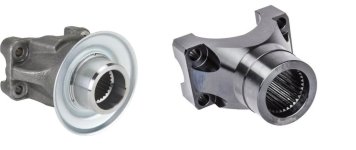
Don't forget that the Daytona pinion bearing is heavy duty, and it is BIGGER, and THICKER. So think about it just a little. The Pinion is the same, the crush collar (or solid spacer) is nominally the same. So the gap between bearings is the SAME. So in order for that to work, the Daytona Pinion support is actually thicker, by about .200 inches. (the distance from the back of the inner bearing to the seal) So the pinion sits short by .200. In order for that to work, the YOKE splines are machined .200 deeper on the non-Daytona yoke, and the flange nut shoulder is machined .200 deeper on the Daytona yoke.

So if you put a standard yoke on a Daytona support...the nut sits .200 high. Just enough to get about 1 thread on the crimped part of the nut.
If you put a Daytona yoke on a standard support, the pinion splines sit proud of the shoulder, and never tighten.
The aftermarket sells a Daytona yoke spacer that pushes the Daytona yoke up, but then the seal runs short on the journal.
Most of the aftermarket gets this WRONG, and lists a single yoke for both applications. The Yukon one is actually machined to fit both, and ends up fitting neither. Once you see it, you can never unsee it.

So the best solution if you run a Daytona Bearing, is to run the Daytona yoke. If this is for your Mustang...you need a passenger car yoke. (long one) If it's for a Bronco, it uses the short yoke. I'm not advocating, or recommending either solution. I'm just telling you so you know. You can always tell when it's done wrong...because the slinger will have a huge gap, or the slinger will be missing. (and of course the amount of thread showing thru the nut is a dead give-away.

The Factory Daytona support and yoke use the Cobra Jet 1330 joint. IDK if your 390 is a 1310, or a 1330.
 

Attachments

  • daytona.jpg
    daytona.jpg
    55.9 KB · Views: 89
  • IMG_3070.jpeg
    IMG_3070.jpeg
    184 KB · Views: 66
  • IMG_3071.jpeg
    IMG_3071.jpeg
    235 KB · Views: 77
Last edited:
Top