



- Joined
- Jul 2, 2022
- Messages
- 22
Are these numbers okay?
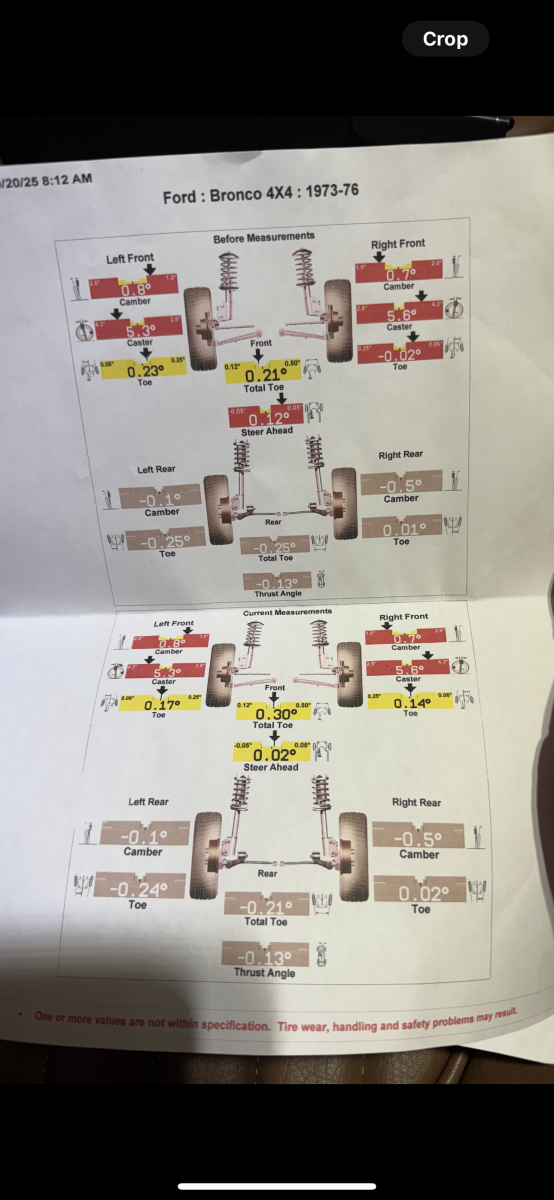









66 with I have no clue what year the frame is 70 plus I’m guessing. JD trex arms with 4 degree bushings , but I’m considering going to 7 degree because it starts to wonder at 55 mph plus. Is the rear toe end concerning at all? I’ve also replaced everything new I might add and added a riser so everything is parallel.I could be missing some subtle detail, of course, but those look great!
Camber is better than average, and better than most. Could be a little less for even more improvement, but we’ve been dealing with worse for a long time.
Your caster is great, so I’m curious how you got there. What year is the bronco? Is it stock height or lifted? Stock c-bushings, or offset?
Any other things done to achieve good caster numbers? They’re higher than the stock ratings, so I’m curious what you did.

Torqued the ubolts the retorqued after a few hundred miles. Everything is torqued and new. Bought the tires last year.I don’t think the wandering is caused by your alignment necessarily. Before changing your C bushings, here’s a few things to check first. Double check to make sure everything is tight in the steering and suspension including the leaf springs and U bolts. How old are your tires? They may have good tread but old tires do weird things. Second I would check tire pressures. Next try rotating the tires to see if that changes anything.
The toe didn’t change in the rearI’m always a little distrustful of alignment sheets that show a change in something that shouldn’t have changed.
Not sure how they changed the toe of the rear axle while it was on the rack, so it kind of sounds like a jiggle in the system.
Unfortunately, I don’t know what problems a little toe in on one side and a little toe out on the other would cause. Overall, I don’t think it’s bad, as there is usually some toe-in on the rear axle I believe.
Others here are more versed in that stuff. I’ve typically only paid attention to the front.
2.5 inch lift and adjustable track bar. Stock pitman arm and linkage etc. I’ve read where 7 degree bushings really helped with high speeds.What is your set up? Any lift? Any changes to the steering linkage or track bar?

Not the total number in the center, but if you look at the left and right, they both changed by .01 degree.
The sensors being jiggled, maybe?

I installed a trac bar riser to get things parallel and left the stock pitman arm. Is the drop trac bar bracket different? Why would a drop pitman arm help?Well, I don’t think it’ll hurt to have more caster. After all, up to a point at least, more is better.
But adding 7° bushings will give you three more degrees than you already have. That’s pretty much 8° of positive caster.
Caster wise, there’s no reason that it shouldn’t steer perfectly at 5 1/2. That’s why it’s still worth looking into other things.
I’ve said it many times, but my personal opinion is that even with only 2 1/2 inches of lift, you should still use a drop Pitman Arm and drop track bar bracket.
But my ‘68 drives 65 just fine, with 5° and I don’t have wandering at any speed.
Well, not compared to most Broncos anyway! Not quite as true tracking as my 71 with just 2 1/2 though.
Have you done the dry Steering test yet? Where a helper wiggles the steering wheel back-and-forth while you watch all the attaching points of everything front and back?
Appreciate the help by the way.OK, so you managed to fit a riser with 2 1/2 inches of lift and got things parallel. So why were they not parallel to begin with? They come parallel from the factory, and lifting it doesn’t create an out of parallel condition. Something must’ve been done to warrant the riser.
Certainly nothing wrong with a riser versus a drop, which is arguably the stronger of the two. The riser that is. But I’m curious what else you’ve got going on there.
Can you post a picture of your front steering linkage?
If you did the dry Steering test recently and didn’t see anything amiss, I don’t know that there’s a reason to do it again.
Although, as you do it more often you get better and better at looking for a subtle little things. Including the steering box, moving on the frame from a crack.
In your case, it could be something as simple as too little or too much toe-in, or tires and wheels that are wider or more offset than optimal.
What size tires and wheels?
I measured 13” , but I had to rush off to work and don’t know if I measured correctly. Here are some more picsInteresting. I know that pictures can often look skewed, but that sure doesn’t look like 2 1/2 inches of lift!
Do you mind measuring between the top of the axle tube at the bottom of the frame rail? Just to confirm?
Even with the riser, the angle on your track bar and drag link look very steep. That’s not good for any speed.
The wandering at higher speed may just be a little vagueness reaction from the high angle.
Then again, it looks like you sort of widened the aspect angle on the camera, so maybe it’s just distorted.
Another thing it looks like your wheels are very offset to the outside (negative). Do you have the specifications on the wheels?
Putting them further out with big tires definitely puts more leverage on the vehicle from the road.

I think so… can you give me an example. Thanks ToddI'd loosen the adjusting sleeve on the tie rod and twist the driver's side a bit so the tie rod end goes squarely into the arm on the knuckle. It looks to be twisted in that picture (zerk fitting should be pointing straight down). This should angle the hole in the tie rod a little more forward from where it is now.
Then loosen and rotate the bottom portion of the drag link a bit so the tie rod end is at a neutral position relative to the drag link (if that makes sense). It appears that the tie rod end is about maxed out in its angularity at rest in the photo.
Todd Z.


