• Welcome to ClassicBroncos! - You are currently viewing the forums as a GUEST. To take advantage of all the site features, please take a moment to register. It's fast, simple and absolutely free. So please join our community today!
    If you have problems registering or can't log into your account, please contact Admin.

Horn contact lube

badandy73

Contributor
Broncoholic
Joined
Jul 18, 2007
Messages
218
Recommendations on a lubricant that can be sprayed into/ onto the horn contacts without removing the wheel?

Forgot what I used when putting in a new turn signal switch about a year ago, but it's recently developed a squeak when turning the wheel any amount and I don't want to have to pull it.

Is there such thing as a copper lube that comes in a spray can?
 

Bitch'nBronco

Contributor
Loose Cannon
Joined
Dec 1, 2005
Messages
3,616
Loc.
Ringwood, NJ
Maybe white lithium spray, tri flow bike chain oil, or try to sneak some grease in with a toothpick, but the right answer is to take it apart and grease it.
 

Broncobowsher

Total hack
Joined
Jun 4, 2002
Messages
37,076
I just used the little capsule that came with the kit. You do NOT want conductive grease, that will short across the contacts. The little capsule sure looks and feels like dielectric grease, which would make sense. Non-conductive, so the grease isn't conducting electricity in an uncontrolled way. But the metal to metal of the contacts will still happen. The grease doesn't keep the parts seperated, it is not a pressurized oiling system spinning on a layer of oil.
 

Steve83

Bronco Guru
Joined
Jul 16, 2003
Messages
9,359
Loc.
Memphis, TN, USA, Earth, Milky Way
There's no spray lube - there's a spray electrical contact cleaner, but since Copper doesn't squeak, it's not likely to help you.

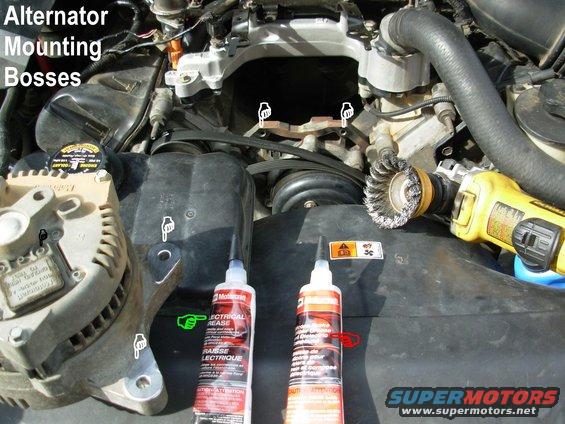
White lithium is bad for sliding contacts. So is dielectric, but electrical grease (which is non-conductive) is the correct lubricant for any electrical terminals or contacts including the mounting surfaces of the alternator.

alternatormountboss.jpg
 

DirtDonk

Contributor
Bronco Guru
Joined
Nov 3, 2003
Messages
51,619
So Electrical grease is nonconductive? I always assumed it was the opposite of dielectric grease. Or never really thought about it that much really. That shows you what assumptions get you.
 

DirtDonk

Contributor
Bronco Guru
Joined
Nov 3, 2003
Messages
51,619
Since I often had trouble with my contacts anyway, after the first re-grease (don’t remember what I used) I converted it over to a horn relay and never had trouble again.
 

Steve83

Bronco Guru
Joined
Jul 16, 2003
Messages
9,359
Loc.
Memphis, TN, USA, Earth, Milky Way
So Electrical grease is nonconductive?
...electrical grease (which is non-conductive)...
;)
I always assumed it was the opposite of dielectric grease.
They're nearly identical, but electrical has much-lower viscosity (lower film strength) so tiny springy terminals can make contact but water is repelled, and NO sand (glass beads) which would physically hold things apart so metal doesn't touch other metal.
 

DirtDonk

Contributor
Bronco Guru
Joined
Nov 3, 2003
Messages
51,619
Thanks for the detail. Helps determine when to use what. I finally have both (I think) on hand.
Back when I was messing with my horn, I'm pretty sure I would have used dielectric, but really not sure I had that handy back in the '70's and early '80's.

But adding a second horn and plumbing in a relay to power them, was one of my favorite mods. Not quite up there with disc brakes, but not bad!

Paul
 

EPB72

Contributor
Bronco Guru
Joined
Jul 13, 2019
Messages
1,208
Loc.
Pleasant Hill, CA
Thanks for the detail. Helps determine when to use what. I finally have both (I think) on hand.
Back when I was messing with my horn, I'm pretty sure I would have used dielectric, but really not sure I had that handy back in the '70's and early '80's.

But adding a second horn and plumbing in a relay to power them, was one of my favorite mods. Not quite up there with disc brakes, but not bad!

Paul
Well it wasn't around in the '70's & 80's...didn't come out till 1990, produced by Nye lubricants NyoGel 760G,,, ,, in 1992 ford adopted this formula for there WSB-M1C239-A (xg 12) part # TSB's were issued at that time for intermittant SRS ABS and ECU faults,

keep in mind this isn't only a ford thing other manufactures used this product , created ther own part #'s as well... Chrysler, Daimler, GM, Black and Decker, Honeywell..others.

If you go to the Nye lubricants web site you can request a free sample , but they contact you before that happens ,
 

EPB72

Contributor
Bronco Guru
Joined
Jul 13, 2019
Messages
1,208
Loc.
Pleasant Hill, CA
I'm pretty sure it was primarily for the 2G alternator terminals. Those components got Gold-plated terminals to address those issues.
XG-12 is engneered for low current ,signal-level sensor circuits . on this era fords not all the ECU terminals were gold plated selected signal circuits yes , these very thin plated terminals were subjected to vibrations that wear the soft metal and possible create resistence , so XG12 is a lubricant to resist the wear, and not insulate the circuit that a thicker dielectric grease can do,so XG 12 in most other connectors as well ,, XG 3-A , really only intended for high voltage secondary circuits, caliper slides and sealing of weatherpack seals . and other uses but not for lower current terminal contact,
XG12 was never intended to be used on high current terminals ,as the 2g fix was an improved heavy duty connector to replace the original , TSB 96-21-4 also no mention of XG12 in that TSB,,
 

Steve83

Bronco Guru
Joined
Jul 16, 2003
Messages
9,359
Loc.
Memphis, TN, USA, Earth, Milky Way
on this era fords not all the ECU terminals were gold plated...
"This era"? We're in a forum for '66-77 Broncos. There were no ECUs (nor EECs nor SRS nor ABS) and no Gold terminals in this era. But in the era of Gold terminals - yes, you're right that not all terminals got that plating. Only those in circuits that would benefit from it, and they did - grease isn't necessary with Gold plating.
...XG12 is a lubricant to resist the wear...
Where are you reading that? Certainly not on the packaging nor the MSDS nor any TSB. TSB 98-24-06 only says it's to prevent water corrosion.
...XG 3-A , really only intended for high voltage secondary circuits...
Dielectric grease is not intended for any circuit of any voltage. The main function is to prevent grounding (which might produce ground loops or shorts) between components & heat sinks. That's why it has sand. It's only used on spark plug boots to prevent them adhering to the spark plug ceramic, and to repel water (also in the distributor cap), but it is not to be used in the spark circuit at all. It's recommended on the rotor tip in the distributor, but that's not a contact - it's to reduce the metal's exposure to the highly-corrosive ozone generated by all the sparks. The spark easily blows a hole through the grease where needed so it doesn't interfere with that circuit.
XG12 was never intended to be used on high current terminals...
I haven't seen any documentation about any upper current or voltage limit for XG12. Do you have a link to that? There IS a lower limit published in TSB 98-24-06 that says not in switches BELOW 0.1A@12VDC. That implies that there's no restriction against high-current terminals.
...the 2g fix was an improved heavy duty connector to replace the original , TSB 96-21-4 also no mention of XG12 in that TSB,,
That TSB doesn't mention a heavy-duty connector any more than it mentions XG12. It only mentions that the connector must be replaced if the terminals show damage. But the new replacement connector is NOT claimed to be improved in any way - it's just new. But TSB 98-24-06 says "ACTION: Add the new grease during electrical connection repair," which would apply to the 2G alternator connector.

 
Last edited:

ba123

Contributor
Bronco Guru
Joined
Oct 29, 2022
Messages
2,757
Loc.
CA
So Electrical grease is nonconductive? I always assumed it was the opposite of dielectric grease. Or never really thought about it that much really. That shows you what assumptions get you.
Technically, you're not going to find anything called "Electrical Grease" that doesn't say exactly what it is.

You're either going to find Dielectric Grease, which is non-conductive or you're going to find Conductive Grease...which clearly is.
 

Broncobowsher

Total hack
Joined
Jun 4, 2002
Messages
37,076
The issue of conductive grease is it getting on things that you don't want it conducting to. If you could be absolutely sure it would never leave the area, it would work. But a little smear across an insulator, that insulator is now a conductor. Non-conductive (dielectric) you can smear that around and it will not bridge contacts. You still have metal on metal for the slip ring to work, but it is lubricated metal on metal.
 
Top