• Welcome to ClassicBroncos! - You are currently viewing the forums as a GUEST. To take advantage of all the site features, please take a moment to register. It's fast, simple and absolutely free. So please join our community today!
    If you have problems registering or can't log into your account, please contact Admin.

Ring of Fire (electrical)

joshua

Contributor
Bronco Guru
Joined
Jun 5, 2007
Messages
1,757
Driving home tonight (dusk) I had lights on.
I caught a glimpse of red glowing ring kind float out from under my dash. I immediately pulled over popped the hood and disconnected the battery. I’m pretty certain I could smell rotten electricity. (Short)

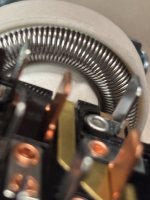
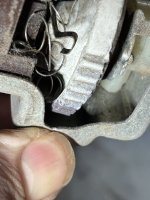
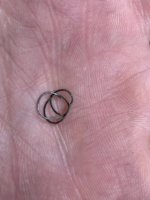
So I searched the floor where I thought I saw it fall the ring fall to, and found this.( 1st pic) I only had 2 miles to home and a fire extinguisher so I chanced and I drove home with my lights off and one hand under the dash feeling wires. When I got home I found this on the floor as well on the other side of the floor board. (2nd picture) I had just vacuumed the floor because I was drilling on the floor the night before so I’m fairly certain these came from underneath the dash and weren’t there. And I’m thinking they were one piece before it got heated.

Anyone know what it is and where it goes? I tried to recreate the problem at home and of course nothing happened with no smells. The main power wire under the dash gets warm with the lights on but far from hot.

If it helps the only thing I was running was the lights and stock gauges. I’m pretty certain I have the amp gauge disconnected tho. The ignition, fuel, pump and wipers are all on their own separate relay’s triggered off the starter solenoid along with all new wires to those items mentioned.

But if someone recognizes this coil thing lmk. It’s not magnetic btw. But it would help tremendously track down where to look.
 

Attachments

  • IMG_0654.jpeg
    IMG_0654.jpeg
    106.2 KB · Views: 66
  • IMG_0656.jpeg
    IMG_0656.jpeg
    130.4 KB · Views: 68
OP
OP
joshua

joshua

Contributor
Bronco Guru
Joined
Jun 5, 2007
Messages
1,757
I went through and looked at my new switch. I’m thinking this is what it is. The coil for the Speedo dimmer
 

Attachments

  • IMG_0657.jpeg
    IMG_0657.jpeg
    111.1 KB · Views: 56

DirtDonk

Contributor
Bronco Guru
Joined
Nov 3, 2003
Messages
51,613
If it helps the only thing I was running was the lights and stock gauges. I’m pretty certain I have the amp gauge disconnected tho.
Aftermarket harness, or factory original? If you disconnected the amp gauge, you must have reconnected the push connector after you separated it from the gauge, or nothing else on the truck would work
Why did you disconnect it in the first place? Just curious. Doesn’t really have anything to do with your current issue, but I’m curious about why you would take the ammeter out of the loop. So to speak…
 

Oldtimer

Contributor
Jr. Member with Sr. moments
Joined
Feb 4, 2005
Messages
1,795
Loc.
Sunnyvale, CA
Paul,
As I recall, back in June he installed a high amp alternator and bypassed the ammeter.
 

DirtDonk

Contributor
Bronco Guru
Joined
Nov 3, 2003
Messages
51,613
Thanks. So "bypassing" meant not using the entire old loop, rather than just bypassing the gauge only.
Clears that up.

Paul
 
OP
OP
joshua

joshua

Contributor
Bronco Guru
Joined
Jun 5, 2007
Messages
1,757
Aftermarket harness, or factory original? If you disconnected the amp gauge, you must have reconnected the push connector after you separated it from the gauge, or nothing else on the truck would work
Why did you disconnect it in the first place? Just curious. Doesn’t really have anything to do with your current issue, but I’m curious about why you would take the ammeter out of the loop. So to speak…
Old timer is correct, I have an explorer alternator. So are you saying I possibly didn’t actually disconnect the amp gauge?

Factor harnessish.., I am running a lot of things on their own relays and power through those are coming of the solenoid post.
 

DirtDonk

Contributor
Bronco Guru
Joined
Nov 3, 2003
Messages
51,613
No, you're probably fine.
As long as you did not re-use the original Black wire that was originally connected to the large BAT post on the back of the alternator that is.
Leaving the other end of the Black wire connected to the starter relay to get power to the rest of the vehicle is mandatory, and does not let current from the more powerful alternator pass through the ammeter. Not that it would do harm to the gauge itself, but the old 10ga wire is not capable of handling the 130-plus amps the alternator is capable of.

Leaving the wire intact at the gauge, as it passes through the inductive loop on the back of the gauge, is correct.
As long as you are not using the wire at the alternator, and are following the usual procedure of up-sizing the charge cable to 6ga or larger, the ammeter is "bypassed" as mentioned.

Just to add to the whole ammeter conversation. Our Bronco ammeters were fairly unique for the time. Unlike standard ammeters, ours could not cause a melt-down, fire, or other catastrophic failure that would let the smoke out of the wires.
Unlike standard, direct-reading ammeters, which could very easily be overpowered and cause a fire, our ammeters were simply sensing the current flowing through the charge/power wire.
The wire itself could be overpowered however, for it's longer length and smaller gauge. Not to mention old age.
The gauge itself was safe. The wire was not.

Just some useless info, in case you were wondering.
Hmm, I wonder if anyone would be willing to test that theory on the bench, which an old Bronco ammeter. Passing something like 200a through the old gauge, with a max reading of 60a on the scale.
That would be a cool test!

Paul
 
OP
OP
joshua

joshua

Contributor
Bronco Guru
Joined
Jun 5, 2007
Messages
1,757
No, you're probably fine.
As long as you did not re-use the original Black wire that was originally connected to the large BAT post on the back of the alternator that is.
Leaving the other end of the Black wire connected to the starter relay to get power to the rest of the vehicle is mandatory, and does not let current from the more powerful alternator pass through the ammeter. Not that it would do harm to the gauge itself, but the old 10ga wire is not capable of handling the 130-plus amps the alternator is capable of.

Leaving the wire intact at the gauge, as it passes through the inductive loop on the back of the gauge, is correct.
As long as you are not using the wire at the alternator, and are following the usual procedure of up-sizing the charge cable to 6ga or larger, the ammeter is "bypassed" as mentioned.

Just to add to the whole ammeter conversation. Our Bronco ammeters were fairly unique for the time. Unlike standard ammeters, ours could not cause a melt-down, fire, or other catastrophic failure that would let the smoke out of the wires.
Unlike standard, direct-reading ammeters, which could very easily be overpowered and cause a fire, our ammeters were simply sensing the current flowing through the charge/power wire.
The wire itself could be overpowered however, for it's longer length and smaller gauge. Not to mention old age.
The gauge itself was safe. The wire was not.

Just some useless info, in case you were wondering.
Hmm, I wonder if anyone would be willing to test that theory on the bench, which an old Bronco ammeter. Passing something like 200a through the old gauge, with a max reading of 60a on the scale.
That would be a cool test!

Paul
The more ya know. Very interesting thanks for sharing!
 

Bruners4

Full Member
Joined
Jul 22, 2019
Messages
282
Loc.
1/2 way to everywhere
@DirtDonk is referring to a Shunt Ammeter. It measures the current flowing through a known resistance metal bar or shunt by measuring the voltage drop between the ends. The meter is calibrated to display this voltage drop in Amps.
I worked on electric material handling equipment running on 12 - 72 VDC and used a shunt to measure motor currents. Some of the 36VDC lift pumps would draw 500+ amps when on the hyd pressure relief valve. A simple DMM was used to measure the voltage drop across the shunt to measure this amount of current.
Great detail can be gained in this article.
 
OP
OP
joshua

joshua

Contributor
Bronco Guru
Joined
Jun 5, 2007
Messages
1,757
Well I think that’s the issue
 

Attachments

  • IMG_0730.jpeg
    IMG_0730.jpeg
    120.2 KB · Views: 27
  • IMG_0731.jpeg
    IMG_0731.jpeg
    172.5 KB · Views: 27

DirtDonk

Contributor
Bronco Guru
Joined
Nov 3, 2003
Messages
51,613
Yep, that'll do it!
Common to have them wear out, but not as common to have them leave smoke and light up under the dash. So you can consider yourself "special" and one of the lucky ones.
Not so much "lucky" that you got to experience it, as much as "lucky" because it wasn't worse!

The new switch is in and working?

Paul
 
OP
OP
joshua

joshua

Contributor
Bronco Guru
Joined
Jun 5, 2007
Messages
1,757
Yep, that'll do it!
Common to have them wear out, but not as common to have them leave smoke and light up under the dash. So you can consider yourself "special" and one of the lucky ones.
Not so much "lucky" that you got to experience it, as much as "lucky" because it wasn't worse!

The new switch is in and working?

Paul
As with many, fire is my biggest fear. Always have the sniffer on high alert!
 

ssray

Contributor
Sr. Member
Joined
Apr 19, 2010
Messages
915
Loc.
South Central NE
@DirtDonk is referring to a Shunt Ammeter. It measures the current flowing through a known resistance metal bar or shunt by measuring the voltage drop between the ends. The meter is calibrated to display this voltage drop in Amps.
I worked on electric material handling equipment running on 12 - 72 VDC and used a shunt to measure motor currents. Some of the 36VDC lift pumps would draw 500+ amps when on the hyd pressure relief valve. A simple DMM was used to measure the voltage drop across the shunt to measure this amount of current.
Great detail can be gained in this article.
[/URL]
Interesting to go back and refresh the brain on the math needed. I imagine You would have been using 50 to 100 millivolt based shunts so .0001 to .0002 ohm values. A principle used in a lot of areas. Even the DMM has a shunt if it has a high amp range plugin connector. And modern welders a lot of us use likely have a shunt used in displaying operating current. Would be interesting to measure the meter movement in a Bronco to see what mv range it uses. Never had mine out so I dont know to what extent they come apart.
 

DirtDonk

Contributor
Bronco Guru
Joined
Nov 3, 2003
Messages
51,613
Would they still be rated the same, even though Bronco ammeters are not shunted?
The later model ones were, and full-size trucks. But the Early Bronco has a simple inductive loop that the wire passes through.
Perhaps it could be looked at as a shunt, although an indirect reading one.
No physical connection.
 

ssray

Contributor
Sr. Member
Joined
Apr 19, 2010
Messages
915
Loc.
South Central NE
Hmmm...if thats the case I would say its working on ac principles measuring the rectified ac current of the alternator. Wouldn't work should you hook it directly to the battery and try to measure dc current out of the battery. Never intended to work that way of course. Might be interesting to know the current draw in a modern vehicle though. Lots of demand with EFI ABS/TCS and electric this and that.

Edit: This search may help Gives some theory and help if troubleshooting an alternator. Good review for me as well!
 
Last edited:
Top