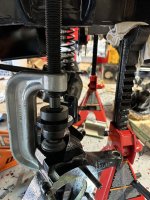
I just did my Ball joints. You can't set the preload, torque the final bolt and then adjust, that's the problem.
But you aren’t supposed to be adjusting after the fact. At least not per the book.
You are setting it initially to where they think it will work best, then testing. (And basically hoping for the best!)
If it needs tweaking, you go back and do it again with a different torque setting on the sleeve. But that's just what we do. It's not what the book says.
Notice that in the book it says essentially, "if after adjusting to our specifications, the pull weight is too much, then you need new ball joints" instead of saying to try adjusting to a different value.
By "new ball joints" I always took that to mean either new ones to replace old ones, or new ones to replace defective or poorly made new ones. Which is what we run into a lot these days it feels like. Assuming that's the issue we have with the sleeve threading all the way out through the yoke year before the specified torque is reached.
Nothing really about resetting, readjusting, and trying again. But we do, and luckily often achieve the desired result. As in Lando's case here.
All resistance to the knuckle spinning is in the ball-joint's ball and socket area. Since the tapered stem is not spinning once torqued, and it's distance from the "ball" is fixed, then talking about preload is all about the ball and socket, with nothing to do with the tapered stem. That part is simply "tight" and that's it.
I'm sure most get this part, but just stating it to bring it out in the open.
You have to torque the lower, then the sleeve to the proper resistance, then torque the top "lock" nut.
Yep, that's what I've been saying all along.
If you do and you did it correctly, yes, you should measure after you're done and it should stay the same.
Well, not really. Why would it stay the same? Lots of potential movement between the various components.
With the sleeve you are literally changing the relationship between the upper and lower ball joint sockets. Moving them closer together or farther apart. No reason that the final pull torque should always remain the same.
I'm sure that it does some of the time. And it sounds like you're getting it there yourself every time? But pretty sure it does not do so all of the time in every case.
I like to cite the wheel bearing scenario. You NEVER and I mean NEVER check your clearance until you have pulled the outer lock nut up tight. The value there has been stated in various books as being anywhere from 30lbs (what!) to as much as 150lbs. I always choose between 70 and 120 lbs on my work, but any of the higher values seem valid and to work well.
The point is though, that before the nut is torqued, backing the inner adjuster nut off the 90° specified leaves the wheel bearing free play HUGE! It would never pass muster.
Once torqued however, all that extra play is gone. That's a ton of metal stretch from the torque applied to the outer end of the spindle.
Is it just the spindle stretching? Don't know, but a lot of things are going on after the final torque.
If you have not torqued the upper nut, how do you know that some of the pull weight is not reduced in value due to the top stud/stem spinning in the sleeve? Tightening the top nut locks everything in it's current position. At least to my way of thinking. Maybe I'm wrong and the pull weight on the steering arm is always the same before and after the final torque.
I can't say I've ever tried to compare, because I've never tested until it was all put together and final torque done. As per the book.
But maybe that's why the new torque spec is 70lbs? Putting more initial on the sleeve probably gets the final value closer to the desired result, resulting in fewer attempts to get it right. That would make sense to me on the surface.
And Paul, I do agree with you on the sleeve comment. My Moog instructions said to torque the sleeve to 70 ft lbs. yeah, no thanks.
Never heard that much until James mentioned it above. Maybe he's going by the same instructions. I wonder when they changed from the 40lbs that's been in the aftermarket books for the last 60 years almost?
Anyone have quick reference to the Dana book we had posted here a few times? I don't remember what it says, but it would be nice to compare.
If you can't achieve 40, or 50 lbs, how the heck are you going to get it to 70! In my last few cases, that would have put it all the way through the steering yoke for sure.
This is a great discussion. I want to see more details about other ball joint setups, and hear how others have achieved their final adjustments.
I do think though, that far too many people try far too hard to get to 26lbs exactly, when it's just supposed to be "less than" that value.
Hopefully this discussion will open up a big sea change in how quickly and easily this job goes.
Paul