






Community

Buy / Sell



Bronco Tech
Fuel Tank Access Plate
3 Arm Wiper Setup
Fix Motor Mount
Roll Cage Braces
Throttle Body 65mm
Wheel Alignment
Heat Riser Replacement
Vent Window Repair
Center Console Mount
Straighten Bumper
Ford 6R80 6 spd
More Tech...
3 Arm Wiper Setup
Fix Motor Mount
Roll Cage Braces
Throttle Body 65mm
Wheel Alignment
Heat Riser Replacement
Vent Window Repair
Center Console Mount
Straighten Bumper
Ford 6R80 6 spd
More Tech...

-
Welcome to ClassicBroncos! - You are currently viewing the forums as a GUEST. To take advantage of all the site features, please take a moment to register. It's fast, simple and absolutely free. So please join our community today!If you have problems registering or can't log into your account, please contact Admin.
You are using an out of date browser. It may not display this or other websites correctly.
You should upgrade or use an alternative browser.
You should upgrade or use an alternative browser.
Wire help, Ground? And a Melted wire.
- Thread starter Anewway
- Start date
OP
OP

Anewway
Jr. Member
- Joined
- Aug 8, 2019
- Messages
- 72
is this the fusible link (arrow)?
Feeling like a real dunce haha.
Nothing on the battery cable.
https://flic.kr/p/2nx1ZNf
Feeling like a real dunce haha.
Nothing on the battery cable.
https://flic.kr/p/2nx1ZNf
OP
OP
Anewway
Jr. Member
- Joined
- Aug 8, 2019
- Messages
- 72
Here's the one by the instrument cluster. (arrow)
You can see the bare copper wire going around the ammeter connection.
https://flic.kr/p/2nx4uM5
You can see the bare copper wire going around the ammeter connection.
https://flic.kr/p/2nx4uM5
Last edited:

- Joined
- Nov 3, 2003
- Messages
- 51,650
The first picture does look like the main fusible link. Is the yellow wire spliced into it as well? Or does the Yellow wire have it’s own?
The second one is not a fusible link. It’s simply a two piece connector. It’s often called a “bullet” connector.
That bare wire and that connector are literally the same wire as was melted everywhere else. Those conductors are bare because the jacket melted off.
And I’m sorry, what year is this bronco again?
- Joined
- Nov 3, 2003
- Messages
- 51,650
In other words, when you are replacing all of that burned wire, this is part of it as it passes through the ammeter.
Our ammeters are direct reading inductive pickup type. Reasonably accurate and very safe.
Not like most ammeters that are physically connected and can burn out themselves.
Our ammeters are direct reading inductive pickup type. Reasonably accurate and very safe.
Not like most ammeters that are physically connected and can burn out themselves.
- Joined
- Nov 3, 2003
- Messages
- 51,650
Ah, good to know for comparisons sake.
The yellow wire is probably connected to the voltage regulator in the “A“ position.
The black wire does look a little small from here, but it should be the very same melted wire as through the rest of the harness.
Either solid black, or black with a yellow stripe. Some years even had a black with a red stripe in some sections, but that was just Ford going through changes.
Maybe it looks old and small simply because it was overheated.
As Rustytruck was bringing up, that fusible link was supposed to protect the wire during a short circuit situation. So either it failed at its job, or rather than a short circuit it was simply overloaded to the point of overheating.
Even then though, I believe the fusible link is supposed to stop it before it melts the whole wire.
- Joined
- Nov 3, 2003
- Messages
- 51,650
And I know they can work because one time I was changing an alternator on a Toyota and I had left the battery connected and accidentally touched the alternator wire to the engine.
Didn’t hurt the wire at all but the fusible link instantly went up in smoke.
Didn’t hurt the wire at all but the fusible link instantly went up in smoke.

I have a stock 68 harness. There is no evidence of a fusible link in the harness, and no mention of one in the Ford shop manual.
Found below comment by Steve83 in another thread:
If it has no fusible link, then the entire wire probably has fusible link insulation (only the insulation is different - not the wire inside).
May explain melted insulation length of wire
Edit:
If you add a 50A fuse to charging circuit it should be closer to the battery (at the starter solenoid) to protect the whole circuit. And if the alternator is capable of more than 50 amps, it may pop the fuse at max output.
Last edited:
- Joined
- Nov 3, 2003
- Messages
- 51,650
Thanks Oldtimer. That’s good info.
Maybe that block at the end of the wire is a simple splice then and not a fusible link section.
I guess there’s one way to find out.
Since that wire is all toasted anyway, pull what’s good out of the harness and short it out!
Using suitable safety precautions and equipment of course…
Or not perhaps. If that section near the starter relay is still good you could retain the factory splice with the yellow wire and splice in new segment of 10 gauge wire between it and the rest of the vehicle.
It needs to be replaced anyway, but any wire that still usable can be.
Personally though I would eliminate it and run all new from start to finish.
And speaking of all new, those grounds look nicely done on the wheel well. Including taking the paint off underneath.
But unless that ring terminal is soldered I would cut off the yellow insulator and put shrink tubing on instead.
You don’t want it deteriorating over time in the under-hood weather.

Rustytruck
Bronco Guru
- Joined
- Feb 24, 2002
- Messages
- 10,872
The black wire on the solenoid with the riopled insulation does that go down to a pgmr starter? Whatever it is its fried too.
- Joined
- Nov 3, 2003
- Messages
- 51,650
No ground from the alternator to the starter relay. Should be from the alternator to the voltage regulator.
It's not that it "can't" work the other way, but it's not as reliable for it's intended use than when it's connected via one of the regulator bolts.
Paul
It's not that it "can't" work the other way, but it's not as reliable for it's intended use than when it's connected via one of the regulator bolts.
Paul
- Joined
- Nov 3, 2003
- Messages
- 51,650
Sorry, guess I should remember that this is an early model and that Ford almost never did anything easy and consistent. Just when we think they did, they changed it up!
But since you're re-wiring all this stuff, might as well mimic the later stuff rather than re-do what did not work as well.
So to what I said earlier, you can keep a ground wire between the alternator and starter relay (because it won't hurt anything) but make sure to separate that second one with the tiny black wire and run it directly from the alternator case to the voltage regulator attaching bolt.
All this is to make sure that both the alternator and the regulator share the same ground potential.
Upgrade and improve when you can.
Paul
So. . . after contemplating Fords cost savings harness design for the early Bronco (up thru 68, maybe till fuse box was moved to glove box) I understand why they did not have a fusible link. You have battery at one end of circuit, alternator at other end, and all the loads in the middle. I also see the benefits of converting from ammeter to volt meter.
Anewway,
If you add a fuse, you may need one at each end, one near battery, and one near alternator.
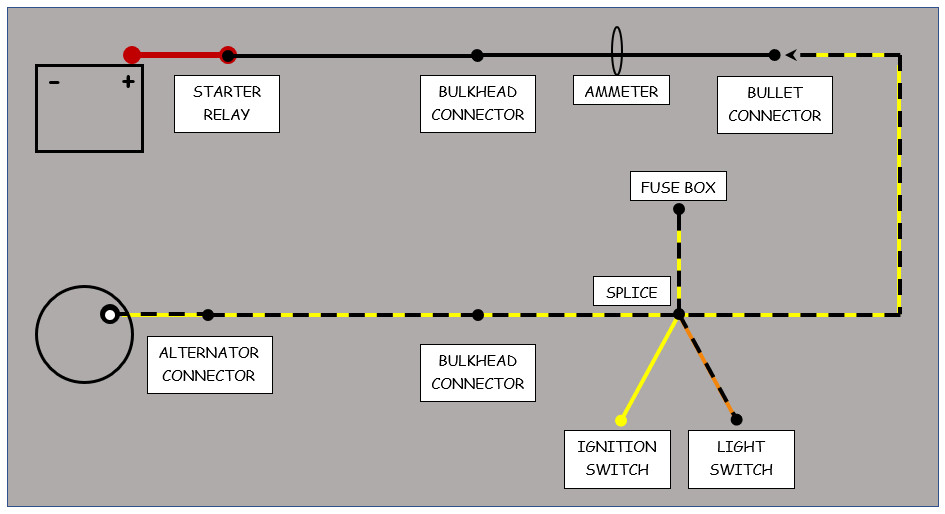
Edit: Fixed wire colors to fuse box & ignition switch.
Anewway,
If you add a fuse, you may need one at each end, one near battery, and one near alternator.
Edit: Fixed wire colors to fuse box & ignition switch.
Last edited:
OP
OP
Anewway
Jr. Member
- Joined
- Aug 8, 2019
- Messages
- 72
Sorry I wasn't clear.. That ground goes from the alternator case to the engine block and then the second smaller wire goes to ground the voltage regulator.No ground from the alternator to the starter relay. Should be from the alternator to the voltage regulator.
It's not that it "can't" work the other way, but it's not as reliable for it's intended use than when it's connected via one of the regulator bolts.
Paul
OP
OP
Anewway
Jr. Member
- Joined
- Aug 8, 2019
- Messages
- 72
Yes I see how 2 fuses would be the best way to protect the harness.So. . . after contemplating Fords cost savings harness design for the early Bronco (up thru 68, maybe till fuse box was moved to glove box) I understand why they did not have a fusible link. You have battery at one end of circuit, alternator at other end, and all the loads in the middle. I also see the benefits of converting from ammeter to volt meter.
Anewway,
If you add a fuse, you may need one at each end, one near battery, and one near alternator.
View attachment 885480
Thanks-
Similar threads

- Replies
- 10
- Views
- 1K

- Replies
- 6
- Views
- 2K