• Welcome to ClassicBroncos! - You are currently viewing the forums as a GUEST. To take advantage of all the site features, please take a moment to register. It's fast, simple and absolutely free. So please join our community today!
    If you have problems registering or can't log into your account, please contact Admin.

Steering is darting is this the likely culprit?

joshua

Contributor
Bronco Guru
Joined
Jun 5, 2007
Messages
1,757
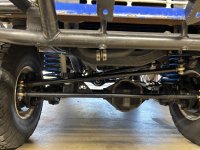
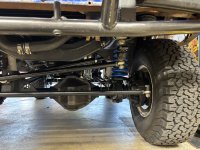
My track bar isn’t in perfect alignment with the drag link. It’s close. But I believe it needs to go up to the next hole on the axle riser. But still wondering if this is likely the reason for the darting back and forth.

I just got it back on on the road after tearing it down to a bare frame. It was built with mostly people left overs so I’m worried maybe things aren’t jiving.

What I do know is correct, is all the radius arm bushings for the size of the lift. I haven’t touched the heim joint steering setup. It did come off a running bronco. So it’s probably close. I am going to an old school 4x4 shop to do a correct alignment on it. But I want it all set up before I go in so they have to as little as possible.

Side note, 3.5 lift on 33x10.5 bfg ko2 all terrains
 

Attachments

  • IMG_0640.jpeg
    IMG_0640.jpeg
    180.7 KB · Views: 164
  • IMG_0639.jpeg
    IMG_0639.jpeg
    214.9 KB · Views: 162
  • IMG_0641.jpeg
    IMG_0641.jpeg
    246.7 KB · Views: 157

DirtDonk

Contributor
Bronco Guru
Joined
Nov 3, 2003
Messages
51,613
A couple of things to do before taking it down to have it aligned. Well, maybe more than a couple.
Yes, you should raise the lower trackbar mount to the upper hole. I'd rather lower the upper mount slightly, but that's more work and your riser has that handy hole right there. So it's easy to experiment.
Second, check all four tire pressures. What are they set at?
Is your steering box centered? Meaning, no matter where the wheel is pointing, and the tires are pointing, is the BOX itself, in the center spot of it's travel. Or more accurately still, is it on the high spot of the gears. Only a manual check will confirm this. More work, but worth it if you don't already know.
Next, do the wiggle test. Familiar with it? If not, let us know and we can give you the full rundown.
What C-bushings are in it? You say "correct for the lift" but are they correct for your Bronco? Nobody knows ahead of time, so we all just use the generic "correction" factor for including bushings. Mostly because almost nobody ever checks their caster before the lift, so we don't know to recommend a higher or lower offset bushing.

Depending on what kind of shop you find, and how much you have to spend, almost nobody is going to do a "full alignment" on your Bronco. They're going to give you a printout, adjust the toe-in (incorrectly most likely) and send you on your way.
I'm not against a check however, and a printout of your readings is a fantastic tool to check how your rig is set up.
I'd adjust the toe-in myself frankly. That way you can also play with it later to find your Bronco's happy spot. Mine were always right about 3/16" toe-in.

But do the wiggle test maybe before anything else.
This test will highlight anything you need to take care of first. Such as, wheel bearings, ball-joints, steering linkage ends, trackbar ends and bolts, rear u-bolts, and just about anything else.
Pay particularly close attention to the upper and lower trackbar mounts. This means ALL of it. The bolts themselves, the holes that the bolts go through (are they wobbling in their mounts), the mounts for flex, the steering box for moving on the frame rail (cracked frame) and all that stuff.

Good luck.

Paul
 

DirtDonk

Contributor
Bronco Guru
Joined
Nov 3, 2003
Messages
51,613
Are those pictures current? If so, then I'd completely remove that steering stabilizer mount from the crossmember. It's dangling.
While it's not likely to catch on anything at the moment, if one bolt falls out and it pivots, that scenario might change.

Have you ever measured toe-in with some tape, a pen and a tape measure?
Reason I ask is that "darting" is not usually just a trackbar out of alignment with the draglink. Unless the roads you're on are particularly bumpy perhaps?
The bit you'll never tune yourself out of though, is that the two bars are no longer even close to the same length. So the shorter trackbar and longer draglink won't let you dial in a perfect setup without some experimentation.
The arc that they travel in might only be a tiny bit difference, but every little thing makes a difference on a Bronco. Especially with power steering and/or low caster numbers.

Speaking of caster, what year is your front axle? Some here say that the Dana axle housings ALWAYS came with a specified amount of caster from their factory. I beg to differ, but at this point (50+ years on that is) it could have changed from hard use, or PO mods, or whatever.
Hence my recommendation to absolutely get an alignment readout showing caster numbers. And don't let the alignment tech say "you don't need the full printout because they're not adjustable" or something like that.
We haven't heard those stories in a few years now, but that used to be an all too common statement from, especially, the younger generation of alignment techs.
Just be sure to get a printout, or at the very least a screen shot of the settings.

Paul
 
OP
OP
joshua

joshua

Contributor
Bronco Guru
Joined
Jun 5, 2007
Messages
1,757
Are those pictures current? If so, then I'd completely remove that steering stabilizer mount from the crossmember. It's dangling.
While it's not likely to catch on anything at the moment, if one bolt falls out and it pivots, that scenario might change.

Have you ever measured toe-in with some tape, a pen and a tape measure?
Reason I ask is that "darting" is not usually just a trackbar out of alignment with the draglink. Unless the roads you're on are particularly bumpy perhaps?
The bit you'll never tune yourself out of though, is that the two bars are no longer even close to the same length. So the shorter trackbar and longer draglink won't let you dial in a perfect setup without some experimentation.
The arc that they travel in might only be a tiny bit difference, but every little thing makes a difference on a Bronco. Especially with power steering and/or low caster numbers.

Speaking of caster, what year is your front axle? Some here say that the Dana axle housings ALWAYS came with a specified amount of caster from their factory. I beg to differ, but at this point (50+ years on that is) it could have changed from hard use, or PO mods, or whatever.
Hence my recommendation to absolutely get an alignment readout showing caster numbers. And don't let the alignment tech say "you don't need the full printout because they're not adjustable" or something like that.
We haven't heard those stories in a few years now, but that used to be an all too common statement from, especially, the younger generation of alignment techs.
Just be sure to get a printout, or at the very least a screen shot of the settings.

Paul
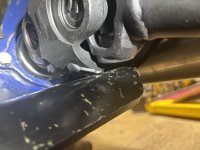
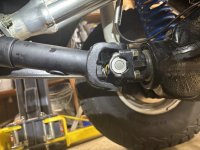
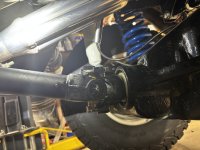
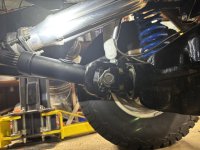
I’ll be sure to check, I am wondering if things are off here with the c bushings as I went to install my new front d shaft and the balance weight is hitting the crossmember so much it would definitely wedge itself.

And I do have the bracket to drop that track bar in a box
 

Attachments

  • IMG_0642.jpeg
    IMG_0642.jpeg
    143.4 KB · Views: 108
  • IMG_0643.jpeg
    IMG_0643.jpeg
    168.8 KB · Views: 105

DirtDonk

Contributor
Bronco Guru
Joined
Nov 3, 2003
Messages
51,613
What engine/transmission combination are you running? Custom cross-member means that you may have this problem no matter what.
You'll have to look at various ways of clearing the x-member with the shaft, but adding more caster via C-bushings is NOT the way to do it.
Neither is reducing caster to get a higher pinion.

If you can't modify the cross-member, or substitute a smaller diameter driveshaft, you'll have to resort to the ole "cut-n-turn" method of correction.
It is, in fact, the ONLY way to correctly set up a front end. The other methods are strictly band-aids (good ones, but not the ultimate) to regain some caster. But all of the others, besides the cut-n-turn method, are compromises directed at caster only. Not the other aspects.

You've been here long enough to have read some of the cut-n-turn threads most likely, but it's the only way to raise the pinion angle to get both a correct u-joint angle (look at your current one to see how bad it is) AND to raise the driveshaft enough to (hopefully) get if off of the support.
With the shaft laying on the cross-member at ride height, you don't even have to go off-road to damage something. Just driving around on the street with some whoop-de-doos will mess something up as the suspension extends.
If lucky, it'll only dent the driveshaft. At the worst however, you could bend it, damage the pinion gear (or even just the yoke) or the output of the transfer case.

So aside from the darting, this is something that absolutely needs to be addressed.

By the way, just to be clear, this is not about "wandering" on the road. Correct? When you say "darting" it's moving around quickly and needs heavy correction to stabilize. Correct?
Darting is pretty nasty sounding. The driveshaft contacting the frame member may actually be playing a role here. Not sure how big of a role, and maybe just a little. But it's something to take into account and fix right away.

Paul
 
OP
OP
joshua

joshua

Contributor
Bronco Guru
Joined
Jun 5, 2007
Messages
1,757
What engine/transmission combination are you running? Custom cross-member means that you may have this problem no matter what.
You'll have to look at various ways of clearing the x-member with the shaft, but adding more caster via C-bushings is NOT the way to do it.
Neither is reducing caster to get a higher pinion.

If you can't modify the cross-member, or substitute a smaller diameter driveshaft, you'll have to resort to the ole "cut-n-turn" method of correction.
It is, in fact, the ONLY way to correctly set up a front end. The other methods are strictly band-aids (good ones, but not the ultimate) to regain some caster. But all of the others, besides the cut-n-turn method, are compromises directed at caster only. Not the other aspects.

You've been here long enough to have read some of the cut-n-turn threads most likely, but it's the only way to raise the pinion angle to get both a correct u-joint angle (look at your current one to see how bad it is) AND to raise the driveshaft enough to (hopefully) get if off of the support.
With the shaft laying on the cross-member at ride height, you don't even have to go off-road to damage something. Just driving around on the street with some whoop-de-doos will mess something up as the suspension extends.
If lucky, it'll only dent the driveshaft. At the worst however, you could bend it, damage the pinion gear (or even just the yoke) or the output of the transfer case.

So aside from the darting, this is something that absolutely needs to be addressed.

By the way, just to be clear, this is not about "wandering" on the road. Correct? When you say "darting" it's moving around quickly and needs heavy correction to stabilize. Correct?
Darting is pretty nasty sounding. The driveshaft contacting the frame member may actually be playing a role here. Not sure how big of a role, and maybe just a little. But it's something to take into account and fix right away.

Paul
Yep I see it, that’s why I made sure to include it. But it is only a 3.5 inch lift. And I’m run an ax15. Is this normal for the pinion to sit like that on only a 3.5 in lift??

Edit: after reading it more carefully I understand. I think I can likely cut a square window out of the bottom of the crossmember then weld a plate back over it. I’ll then lift up the front to make sure it clears at full droop. I’m probably not going to wheel this super hard. I’m much more worried about road manners.

The steering is definitely not wondering. It’s like every once in a while it does a quick pull then back the other way.

My garage floor drops like 4 inches with in a five foot span so I took some pictures with the jack leveling the axle. Looks different to me but I might be crazy
 

Attachments

  • IMG_0647.jpeg
    IMG_0647.jpeg
    150.9 KB · Views: 68
  • IMG_0649.jpeg
    IMG_0649.jpeg
    162.3 KB · Views: 66
  • IMG_0648.jpeg
    IMG_0648.jpeg
    122.3 KB · Views: 65
  • IMG_0646.jpeg
    IMG_0646.jpeg
    116.5 KB · Views: 64
Last edited:

DirtDonk

Contributor
Bronco Guru
Joined
Nov 3, 2003
Messages
51,613
For now, I would remove the front shaft completely. Just set it in the garage and forgo any wheeling until you get the crossmember modified.
That would also serve to prove out whether or not the shaft hitting has anything at all to do with the darting.

For darting, I would absolutely check your toe-in!
Oh, and air pressure. Because those are super easy.

Paul
 

DirtDonk

Contributor
Bronco Guru
Joined
Nov 3, 2003
Messages
51,613
For quickie toe-in measuring, I use tape and a tape-measure.
I eyeball a good common tire tread lug in-line with the wheel mounting surface (front of the hub and drum or rotor). Pick a lug that is at the very front, or very rear (better) of the tire.
Eyeballing is fine, since otherwise you usually end up using the sidewall which is as inconsistent sometimes as tires get.
Then find the matching lug on the other tire.
Pick a lug that has as flat a side as you can, to help retain the tape-measure hooky/thingy.
Apply some tape over that lug.
I mark a line right along the edge of the lug on the tape.
The rear is "better" to do first, simply because I believe that this eliminates certain discrepancies inherent in vehicle wheel dynamics. Or something along those lines.

Measure between the lines. Write it down (unless your memory is very good and clear).
Roll the vehicle forward until the tape is facing directly to the front (or rear depending on which end you started on).
Measure that one and compare the two.
The difference is your toe. Whether in or out...

Stock measurement is between 1/8" and 1/4" toe-IN. With 3/16" being considered ideal.
I have oddly found over the years, that no matter my wheel and tire combo, 3/16" was what felt the best every time.

Modern equipment uses "degrees" of angle of the steering axis. This is fine and dandy if you use a conversion chart for inches, because (at least in my opinion) your toe-in "degree" gets all out of whack when you have non-stock tire sizes.
A 2° offset with 28" tires is not the same at the ends of the tires as it is with a 35" tire. So that's my argument for doing it at home and using a tape measure in inches, rather than using the more modern degree ranges.

Paul
 

Apogee

Contributor
Bronco Guru
Joined
Nov 26, 2005
Messages
6,345
Loc.
Tangent, OR
"Darty" could be a few things, but you definitely have some bump steer with the misalignment between your drag link and track bar, though I'd be surprised if that's the whole issue. Toe and caster and even tire air pressure can also play significant roles in how the rig handles at speed. How did you set your toe? While I get that you haven't gotten it aligned, what angle C-bushings are you running with your 2.5" lift? I know that on my '77, my front driveshaft was at or near binding at 3.5"SL ride height with just 7° bushings and factory arms, which then got worse when I added CAGE long-arms...driveability was much better, but driveshaft u-joints were not happy. As for air pressure, I generally ran my 33" BFG M/T's at about 28/26 PSI when empty and 32/30 fully loaded with gear.
 
OP
OP
joshua

joshua

Contributor
Bronco Guru
Joined
Jun 5, 2007
Messages
1,757
I have everything at 35 psi. All I have in the bronco is 2 seats. I went to a local commercial plumber and grabbed some scrap 3 in pipe for the notch. I can’t find a 3/4 fine thread bolt anywhere locally for the track bar so I’m just going to order one from WH.

And it definitely could be bump steer as driving around it’s not always doing it now.

It’s only an issue at over 45 mph

To measure can I just strap or tape angle iron to the side of the tires and measure off that? Idk if that would be easier?
 

Broncobowsher

Total hack
Joined
Jun 4, 2002
Messages
37,060
The bumpsteer usually isn't darty. It is a sawing of the steering wheel side to side as the front suspension cycles up and down.
Caster and toe out are generally the darty ones in the front. Don't rule out rear suspension as well. A little twitch of the rear end will be darty and you will be chasing it in the front.
Track bar mount and steering box flex (cracked frame, bolted parts sliding around) are bad as well.

Not saying the track bar angle are not a problem, I just don't think they are the problem you are chasing at the moment.
 
OP
OP
joshua

joshua

Contributor
Bronco Guru
Joined
Jun 5, 2007
Messages
1,757
The bumpsteer usually isn't darty. It is a sawing of the steering wheel side to side as the front suspension cycles up and down.
Caster and toe out are generally the darty ones in the front. Don't rule out rear suspension as well. A little twitch of the rear end will be darty and you will be chasing it in the front.
Track bar mount and steering box flex (cracked frame, bolted parts sliding around) are bad as well.

Not saying the track bar angle are not a problem, I just don't think they are the problem you are chasing at the moment.
I had this torn down to the frame, sand blasted and I painted it. Is definitely not cracked. I rechecked all bolts and are all torqued. The only thing I can think of that would have to do with bolts, would be the pitman arm. As I drilled it out the same size as the bolt going through. I read later that I probably should have drilled on size smaller.
 

hunter1

Contributor
Sr. Member
Joined
Feb 2, 2013
Messages
519
Loc.
Maryville, Tn
I have everything at 35 psi. All I have in the bronco is 2 seats. I went to a local commercial plumber and grabbed some scrap 3 in pipe for the notch. I can’t find a 3/4 fine thread bolt anywhere locally for the track bar so I’m just going to order one from WH.

And it definitely could be bump steer as driving around it’s not always doing it now.

It’s only an issue at over 45 mph

To measure can I just strap or tape angle iron to the side of the tires and measure off that? Idk if that would be easier?
I would let 5-7 psi out of your tires all the way around and try it. Have a TJ that did the same thing with 33-12.50 Goodyear Kevlar MTR's on it and that took care of 90% of it. I actually run 26 psi in them now.
 

m_m70

Contributor
Bronco Guru
Joined
Jun 14, 2001
Messages
1,769
Loc.
Prescott AZ
I would let 5-7 psi out of your tires all the way around and try it. Have a TJ that did the same thing with 33-12.50 Goodyear Kevlar MTR's on it and that took care of 90% of it. I actually run 26 psi in them now.
this helped mine out.....running 28 in the front and 26 in the rear. drives straight and returns nice
Don't rule out rear suspension as well. A little twitch of the rear end will be darty and you will be chasing it in the front.
This was another issue I had with darting..........U-bolts and shackles weren't torqued right and man did it let me know.....
 

SLOWnEASY

Contributor
Sr. Member
Joined
Sep 26, 2022
Messages
517
Loc.
San Diego, Ca.
I run 31x10.50's and I keep my pressures at 28 psi. The Bronco handles much better and the tires wear more evenly at that pressure
 

rjrobin2002

Contributor
Bronco Guru
Joined
Oct 13, 2007
Messages
2,947
Get your fatest girlfriend to jump on the front bumper and watch the steering wheel and see if it moves.

Then go up on to the Top hole on the axle track bar mount and have her jump on the bumper again and see if the steering wheel moves.

That's how I know I got the bump steer gone.

Then tighten all steering box bolts good and have someone wiggle the steering wheel and look for frame or axle track bar mount flex and tie rod movement. Jack the front axle in the air and check wheel bearing and ball joint slack.

Then go get alignment numbers and find out if you need more caster or camber, get a print out.
 
Top