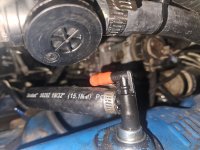
Ahhh. Yes, that is an aftermarket vacuum cap thingy from the local auto parts store.
Have you sprayed around the whole engine to check for vacuum leaks? I think you said here, or in another thread, that you had done that.
But the blue cap thingy is a perfect place to spray because they are notorious.
It's not rubber, more of a plastic type cap that comes in the little variety packs now.
Yeah, possibly polyurethane?
The actual brass adapter is whatever was on there when I got the Bronco, so I have no idea what is supposed to be there.
Factory unit up to probably 75 or so.
Was part of the dual diaphragm vacuum advance/retard setup. Possibly EGR vacuum as well, although I think that was from the carburetor.
As possible that it’s simply the earlier type, because a vehicle with an automatic and EGR and the dual diaphragm distributor might have needed more hose fittings.
In the early days that was called a “vacuum manifold“ but on some vehicles and on most later vehicles, it was referred to as a “vacuum tree“ because the designs actually did look like a tree with different branches.
If you’re looking for things and call it a vacuum tree, everyone should know what you’re talking about.
Looks like you have enough fittings, as long as they’re the correct size for what you need.
No reason necessarily to revert back to a steel tube down to the automatic transmission. But if you happen to find one already bent up and ready to go, you can retrofit it.
I seem to remember most of them having a vertical loop before it goes down under the tunnel. Perhaps to keep liquids or oil vapors from draining down into the lower mounted transmission modulator.
The passenger side rear cover is the PCV location on this engine.
It’s very possible that Ford mixed them around year by year with different options. Perhaps engines with EGR and an air pump had the valve relocated. Don’t know.
I have seen a lot of Broncos with air pumps, but don’t remember noting the PCV location on each one.
And the valve that is in there has a tree, with one large port and one small one.
Also a common orientation. Some vehicles use the upper port, some did not. The ones that did were probably later vehicles with more things to control.
But it’s important that you have the valve meant for the engine. They are not all the same with the same weighted pill inside. Some can make your as you run, extremely lean, acting like a big vacuum leak.
If your engine is ever acting lean, pull that out and plug it and see what happens.
Sounds like it’s running pretty good now, though, so I wouldn’t necessarily mess with it!

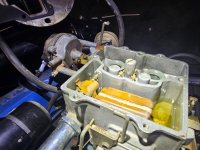
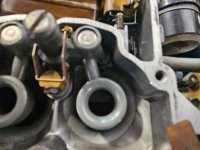
The large port goes to the carb spacer base and the hose size is way bigger due to the port on the carb spacer being much larger than the PCV fitting port.
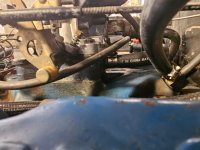
Yep, that was factory. They used a double molded curved hose to fit the valve and the spacer.
I wanted to clean mine up, but had a hard time duplicating that.
Luckily my factory hose was in great shape up until the time I got an aftermarket carburetor with a matching 3/8 inch fitting.
I know that can be problematic at time with secondary issues resulting from incorrect parts, but I figured a PCV valve is a PCV valve as long as it seals correctly.
See my comment above.
They are definitely not all the same! There’s even an aftermarket company now, that we’ve talked about here before, that makes a custom turnable PCV valve to match your exact engine.
Not needed for a stock engine, but if you’ve modified it with cam intake and headers, those needs have changed.
On another note... After discovering the missing head on that intake bolt, I did a check on the other intake bolts and re-torqued them all. Circle/X-Pattern starting from center then out. First sequence was to 20lbs, second was to 25lbs. About half of them middle to rear of block were not even to 20 lbs. Front of intake were all at least to 20lbs. Everything on there now is torqued to 25lbs.
Good luck. Hope it works because i’ve seen retorqued intakes start to leak!
It fired up and it idled very well yesterday after putting it all back together.
If it idles well, that sounds like you don’t have any serious vacuum leaks.
Paul

















 .