• Welcome to ClassicBroncos! - You are currently viewing the forums as a GUEST. To take advantage of all the site features, please take a moment to register. It's fast, simple and absolutely free. So please join our community today!
    If you have problems registering or can't log into your account, please contact Admin.

Won't Idle, Carb, Possible Timing, and Definite Can of Worms Issues

OP
OP
JeepGuy

JeepGuy

Contributor
Bronco Guru
Joined
Aug 24, 2006
Messages
1,521
You can also have uncontrolled fuel getting into the intake past the power valve diaphragm into an intake vacuum port. This will also drain the fuel bowl of fuel overnight when leaking a lot. This causes the engine to have to crank until there is enough fuel pumped into the carb fuel bowl to allow it to start. This leaking fuel will also cause a hard hot start as the extra fuel leaked into the intake manifold causes a rich mixture.
Power valve has been replaced each time I've rebuilt it. Bronco actually fires up pretty quick when cold after a couple cranks so I don't think that is the issue. If I pull the carb again I might just put in an #8 and see if that works.
 
Last edited:
OP
OP
JeepGuy

JeepGuy

Contributor
Bronco Guru
Joined
Aug 24, 2006
Messages
1,521
Unmetered fuel will appear as droplets. You might see a fine mist, other than that you shouldn't see any fuel in the throat of the carb.

Don't forget to check for other vacuum leaks.
So, At idle looking down into the carb I can see fuel coming from the upper booster ports (that's the only way I can describe them). Fuel also comes out of those ports every time I add throttle.

The mixture screw inlets I believe are under the lower butterfly, so I can not see them at idle.

I did have a thought as far as adjustments... Currently my idle control screw does not even touch the plate on the linkage, meaning I can not lower the idle using that adjustment screw, and the lower butterfly's will not close any further than they are. I'm going to adjust that idle screw as if I'm trying to add rpm's, then screw in the idle mixture screws on the bottom of the carb and see if I can get any adjustability that way. They are currently both somewhere between 2 - 2 1/2 turns out. I've read they are generally adjusted to anywhere between 2 1/2 to 1 1/4 on these old carbs.

Something is off, but I'm definitely not an expert here.

After a couple good heat cycles on the engine I checked the carb mounting bolts and they still had some play in them. I did replace the heat insulator that goes between the carb and mounting plate, and I'm wondering if that needed to be broke in a bit. After tightening down the carb mounting bolts I went around spraying brake cleaner at the linkage on throttle side and choke side with no noticeable difference in idle. Going to repeat that process later today to see if I get the same results. If I get any change I'll just order the reamer and insert kit and pull the carb again... Nothing to lose at this point by trying that fix.
 

gnpenning

Contributor
Bronco Slave
Joined
Dec 26, 2011
Messages
2,597
Loc.
I have more questions than answers.
Only fuel that should be getting thru at IDLE is below the throttle plates anything above is not being metered through the idle circuit. Google carb circuits. Currently you don't care about anything other than the idle circuit. Until you get this problem resolved you will never get the idle mixture screws or adjustment set properly.

I have no idea how or with what you cleaned the carb or how you set the float level up. Details matter. Just saying you rebuilt the carb twice gives zero context. Right now we are just spitting into the wind and hoping nothing hits us in the face.


I have no idea what year or if you have a California or federal emissions. At the very least you have vacuum lines going to the vacuum advance and most likely other places. These need to be checked as well.

Pictures are very helpful. You can take them with your phone and transfer here.


Keep in mind we aren't even talking about the reason it quits when hot. You likely have more than one problem. Fix one at a time. Don't go throwing a bunch of parts until proving what is actually wrong.
 

Bruners4

Full Member
Joined
Jul 22, 2019
Messages
282
Loc.
1/2 way to everywhere
If you are seeing fuel dripping out of the accelerator jets above the venturi bores, there could be a couple of additional things to cause that. There is an accelerator check ball that has a weight on top of it. This weight prevents fuel from being pulled from the accelerator pump circuit unless the diaphragm pumps or pushes fuel against the check ball and lifts it allowing fuel to enter the venturi through the jets. Also, if the fuel level is too high in the fuel bowl, it can seep out the accelerator jets. Just a couple of little things to check.
 
OP
OP
JeepGuy

JeepGuy

Contributor
Bronco Guru
Joined
Aug 24, 2006
Messages
1,521
@oldiron I picked up a new condenser for 20 bucks. Easy thing to replace so why not. The points are clean and there is a good visible spark in there so I didn't bother changing them.

@Bruners4 Yes. I've been messing with it this afternoon and after a little better inspection, while idling (still has to be at least 1000 rpm's) I can see fuel dripping from the venturi's. At first I thought it was the little squirters but nope. Those only squirt when I push the throttle. I'm going to pull the venturi assembly and double check that the check ball went back in there. I know for sure the rod on top of it is there, just not sure about the ball. :cautious: I'm crossing my fingers that is the issue here.

@gnpenning Pictures you say.... Don't threaten me with a good time!

It is a 1974 with a stock 302. Carb is a Motorcraft 2150. As far as I can tell there is no EGR remaining on this vehicle since I've owned it.
PCV vacuum goes to the mounting plate under the carb.
Lower passenger rear vacuum port goes around to the front lower drivers vacuum port.
Distributor pulls vacuum from lower port, passenger side in front of choke assembly.
Bowl vent goes around and into Air Cleaner base plate port on back of carb (non vacuum).

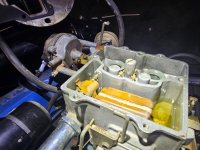
Bowl is at full level in the pictures below. As mentioned to Bruners4, I've discovered with a bit of a better look that fuel is coming from venturi's on idle. That is obviously a problem that I'll be looking into

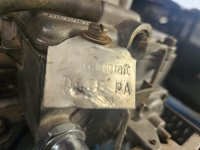
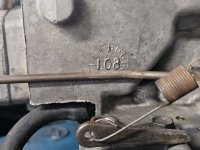
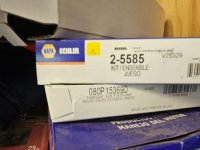
It appears the power valve is a 7.5 from indicated carb rebuild kit I picked up from Napa as shown.
 

Attachments

  • 2150 overview.jpg
    2150 overview.jpg
    191.5 KB · Views: 98
  • 2150 identifier tag.jpg
    2150 identifier tag.jpg
    135 KB · Views: 55
  • 2150 bowl identifier.jpg
    2150 bowl identifier.jpg
    173.3 KB · Views: 94
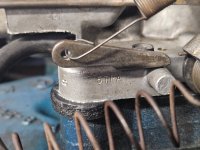
  • 2150 plate identifier.jpg
    2150 plate identifier.jpg
    166 KB · Views: 80
  • 2150 topless.jpg
    2150 topless.jpg
    155.7 KB · Views: 91
  • 2150 Venturi Top View.jpg
    2150 Venturi Top View.jpg
    165.1 KB · Views: 83
  • 2150 vacuum rear of carb.jpg
    2150 vacuum rear of carb.jpg
    131.9 KB · Views: 90
  • 2150 idle screw.jpg
    2150 idle screw.jpg
    159.1 KB · Views: 63
  • 2100 2150 idle mixture screw inlet port.jpg
    2100 2150 idle mixture screw inlet port.jpg
    89.6 KB · Views: 61
  • 2150 Rebuild Kit.jpg
    2150 Rebuild Kit.jpg
    108.9 KB · Views: 45
Last edited:
OP
OP
JeepGuy

JeepGuy

Contributor
Bronco Guru
Joined
Aug 24, 2006
Messages
1,521
Here is another discovery... While checking again for vacuum leaks with engine running, I ended up spraying around the border of the intake manifold and there was a noticeable difference in idle increase. I'm beginning to think I might have vacuum leaks at the intake gasket levels as well which would explain a lot. Keep in mind, this engine ran awesome until I parked it for at least a decade. I have a few hundred run time miles on it since getting it fired back up so no surprise to me, I'm starting to find little gremlins that appear on these engines when they sit not running for long periods of time.

Which brings me to my next decision...

My goal was to verify that all the corrections, installations, replacements, upgrades, etc... of parts over the last two years are functioning as they should. I intentionally left the engine and trans untouched. As far as I can tell with the drive time I have thus far, the suspension, brakes (still need tweeking but definitely working) wiring harness, interior gauges, etc... are all working as expected. I've always had the goal of at a minimum upgrading the ignition system, intake manifold, and fuel delivery.

Given the new discovery of a potential intake manifold gasket leak, I'm leaning more towards pulling the trigger on either a pieced together used Fuel Injection system, new complete package deal, or at a minimum Intake, Dizzy/Ignition, Throttle Body upgrade. Leaning VERY HARD towards the Pro-Flo system as it checks all those boxes at once.

Decisions decisions....
 

Oldtimer

Contributor
Jr. Member with Sr. moments
Joined
Feb 4, 2005
Messages
1,795
Loc.
Sunnyvale, CA
Currently my idle control screw does not even touch the plate on the linkage, meaning I can not lower the idle using that adjustment screw, and the lower butterfly's will not close any further than they are.

Show us a picture of the choke linkage and fast idle screw. Is it holding the throttle plates open?

An this is a vacuum leak:
1778893752391.png
 
OP
OP
JeepGuy

JeepGuy

Contributor
Bronco Guru
Joined
Aug 24, 2006
Messages
1,521
Show us a picture of the choke linkage and fast idle screw. Is it holding the throttle plates open?

An this is a vacuum leak:
View attachment 961984
The lower butterfly's are as closed as they possibly can be. It was too a point where the idle adjustment screw on the drivers side throttle linkage wasn't even touching the plate. Made no difference.

I'm pretty sure I resolved that gasket issue. Probably pulling the carb back off again tomorrow to triple check a couple things and I'll try to get good pics of the base and linkages.
 
OP
OP
JeepGuy

JeepGuy

Contributor
Bronco Guru
Joined
Aug 24, 2006
Messages
1,521
Little update.

New gaskets are on order for between the base plate and carb.

I pulled the carb and disassembled it again. While checking the power valve that was just put in it appears the baffle on the inside is very wavy. Can't tell if it's cracked or actually broken. I put the one I had just removed back in. Re assembled the carb reset the fast idle screws and choke side idle screws... HIGH IDLE ISSUE IS GONE when the engine is cold and warming up. Fired up and ran smooth.

I looked down the top and there is no longer any fuel out of the venturi's or little booster ports at idle. Of course when I add throttle they kick in.

Still has idle issues when it warms up which I think may be vacuum leaks becoming noticeable when the engine warms up. Plan for the moment is just wait until the new gaskets show up and see if they help at all.

Took it out for a drive without issue related to fuel delivery or cruising down the road. The random shut off issue did not reoccur. Guessing that loose coil wire I found may have been the culprit there.
 
OP
OP
JeepGuy

JeepGuy

Contributor
Bronco Guru
Joined
Aug 24, 2006
Messages
1,521
Wellllll... because why not?

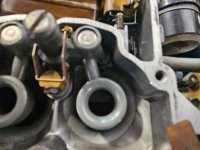
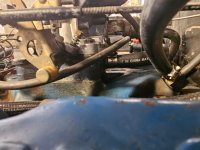
Can of worms confirmed. Most of my vacuum leak issues may have been hiding in plain sight this whole time.
Can of Worms Confirmed.jpg
 

DirtDonk

Contributor
Bronco Guru
Joined
Nov 3, 2003
Messages
51,613
Sooo...
Missing the business end of that bolt there are 'ya?
That would certainly end up letting some leakage occur at the back corner. Amazing that we don't see much in the way of oil though. When front bolts get loose, oil likes to come out to.

Is the larger hose (3/8" most likely) connected from the back of the carb base fitting directly to the elbow fitting on the valve cover? Hmm...
Or, as they say, well there's your problem right thar!
What does the other valve cover have in it? For a '74, the PCV valve was in the driver's side cover in the front and the elbow for filtered return-air was in the back on the passenger side.

From the factory, the small line there going down to the vacuum modulator was a metal tube with just rubber hose at each end. For good reason...

The brake booster hose looks to be fitted to a fitting that is smaller than the hose and that clamp is tightened down pretty muchly.

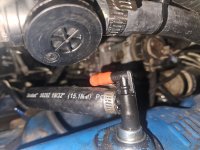
And lastly, check that blue vacuum cap for cracks. Looks like a factory cap, in which case it's probably ok. But if it's been replaced with aftermarket, it's probably leaking.
 
OP
OP
JeepGuy

JeepGuy

Contributor
Bronco Guru
Joined
Aug 24, 2006
Messages
1,521
Sooo...
Missing the business end of that bolt there are 'ya?
That would certainly end up letting some leakage occur at the back corner. Amazing that we don't see much in the way of oil though. When front bolts get loose, oil likes to come out to.
I won't say it out loud, because you know what will happen if I do. So, I'll say it this way... my garage floor is generally puddle free and the underside of the Bronco has the normal misty build up, but nothing significant... surprisingly.

Is the larger hose (3/8" most likely) connected from the back of the carb base fitting directly to the elbow fitting on the valve cover? Hmm...
Or, as they say, well there's your problem right thar!
What does the other valve cover have in it? For a '74, the PCV valve was in the driver's side cover in the front and the elbow for filtered return-air was in the back on the passenger side.
Excuse me sir. That is not a 3/8" hose. It is a 11/32"... come on man, get with the program. :ROFLMAO: That hose is actually just a smiggen smaller than the fitting it is on and that fitting port is the same size as the port into the intake. Big hose goes to PB system, smaller hose goes to C4.

From the factory, the small line there going down to the vacuum modulator was a metal tube with just rubber hose at each end. For good reason...

The brake booster hose looks to be fitted to a fitting that is smaller than the hose and that clamp is tightened down pretty muchly.

And lastly, check that blue vacuum cap for cracks. Looks like a factory cap, in which case it's probably ok. But if it's been replaced with aftermarket, it's probably leaking.
Not sure what went were factory on this Bronco. It was almost in this same configuration when I got it, and by then most of the EGR stuff had been removed... because you know it was out of California of course so no laws were broken in doing so... Lol.

I'm actually not sure if this came with PB originally or not. When I picked up all those years ago there was already a PB booster on there. There has always been a vacuum hose running from the base plate of the carb to the rear passenger side valve cover, and the front drivers side valve cover just has a breather/filler.

And the "Blue Cap" on the back of the intake is not a cap. I thought the same thing when I saw it. It's just a flat plate with three threaded holes where I'm assuming part of the factory EGR system was mounted. I've sprayed that thing directly with brake cleaner from several angles with the engine warmed up and running with no effect on idle at all. Now of course because I said that this morning, when I get out there it will in fact be a cap and leaking. 🤷‍♂️ :ROFLMAO:
 

DirtDonk

Contributor
Bronco Guru
Joined
Nov 3, 2003
Messages
51,613
Rats! Looks like I’m gonna have to get my eyes recalibrated for hose sizing. 😉😁.

Not the blue EGR block off plate. I meant the blue rubber vacuum cap on the small unused hose nipple on the vacuum manifold.

Can you show the detail of the back valve cover fitting then? If it’s not a PCV valve, then it’s not correct.
Given the size of the hose, however, it is looking like the back has a valve rather than an elbow. The elbows are larger diameter. So the hose probably wouldn’t fit.
Still curious, though, what it’s connected to.

The engine doesn’t care whether the PCV valve and vacuum is coming from the driver side front or the passenger side rear. Just that it’s metered from one and filtered back in from the other.
Up to 1970, they were in the back passenger side. 71 and later they were in the driver side front.
 
OP
OP
JeepGuy

JeepGuy

Contributor
Bronco Guru
Joined
Aug 24, 2006
Messages
1,521
Rats! Looks like I’m gonna have to get my eyes recalibrated for hose sizing. 😉😁.

Not the blue EGR block off plate. I meant the blue rubber vacuum cap on the small unused hose nipple on the vacuum manifold.
Ahhh. Yes, that is an aftermarket vacuum cap thingy from the local auto parts store. I'll check it out. It's not rubber, more of a plastic type cap that comes in the little variety packs now. The actual brass adapter is whatever was on there when I got the Bronco, so I have no idea what is supposed to be there. I will for sure double check that cap and more than likely either find the proper vacuum adapter for the Booster and Trans, or at a minimum replace the cap.
Can you show the detail of the back valve cover fitting then? If it’s not a PCV valve, then it’s not correct.
Given the size of the hose, however, it is looking like the back has a valve rather than an elbow. The elbows are larger diameter. So the hose probably wouldn’t fit.
Still curious, though, what it’s connected to.

The passenger side rear cover is the PCV location on this engine. And the valve that is in there has a tree, with one large port and one small one. The large port goes to the carb spacer base and the hose size is way bigger due to the port on the carb spacer being much larger than the PCV fitting port. That one is sinched down tightly over the port for sure. I was looking for just your basic PCV elbow type when I put that in there, but that's all they had. Now that I'm getting into trying to get this all correct, vs. just getting it drivable on the road to test other things, I'll be going back through and trying to source legit/correct parts. I know that can be problematic at time with secondary issues resulting from incorrect parts, but I figured a PCV valve is a PCV valve as long as it seals correctly. 🤷‍♂️
Rear PCV.jpg

The engine doesn’t care whether the PCV valve and vacuum is coming from the driver side front or the passenger side rear. Just that it’s metered from one and filtered back in from the other.
Up to 1970, they were in the back passenger side. 71 and later they were in the driver side front.
Given how I obtained this Bronco and from who, I'm guessing this engine is not original, and who knows what internally it has. I will say when I bought this way back, it was very stockish but drove very well. I followed SoCalBroncos up and over Holcomb Creek and John Bull with limited slip diffs, stock height, 31" tires, cut fenders, and the carb you are seeing on it in the pics. There were no engine issues prior to me parking it for over a decade. I figure this is just what I get for not maintaining and exercising this Bronco over the years.

On another note... After discovering the missing head on that intake bolt, I did a check on the other intake bolts and re-torqued them all. Circle/X-Pattern starting from center then out. First sequence was to 20lbs, second was to 25lbs. About half of them middle to rear of block were not even to 20 lbs. Front of intake were all at least to 20lbs. Everything on there now is torqued to 25lbs.

At this point The Carb is all back together. Only part that has been replaced this time was the Power Valve which seemed to solve the fuel coming out of the venturi's at idle. Top of carb is "dry" so to speak until you burp the throttle. I did end up reaming the throttle shaft opening on the driver side only and putting in the provided grommets to attempt to seal up that potential leak. Regretting that a bit as the grommet/sleeve is very snug around the throttle shaft itself but does not seat tightly into the carb. There is now zero play in that shaft up down, side to side, or wiggle at all, and it goes smooth across the base of the carb. So I know it was reamed as straight as possible, just don't like how the grommet/sleeve seats into the base. I added a bit of Gasoline/Fuel rated Permatex sealer around the grommet/sleeve itself, then your standard engine high temp around the outside edge. of that grommet/sleeve where it sits in the carb. We'll see how that holds up.

It fired up and it idled very well yesterday after putting it all back together. Double checked timing and it's at 12-13 degrees advanced. Idle speed in neutral still bounces a bit between 800 - 850ish. In gear 650 - 700ish. I'm getting these numbers of a timing light so take them for what they are worth. Exhaust note sounds healthy unlike last week when there was a very obvious flutter and something was off.

I do have a new PerTronix coil, wires, and a stock replacement ignition condenser to put on. I should replace the stock points too I guess. Too cheap at the moment to add the PerTronix ignition so it will be points for a bit. Should be driving it around a bit today to see if what I've done has had any effect.
 

DirtDonk

Contributor
Bronco Guru
Joined
Nov 3, 2003
Messages
51,613
Ahhh. Yes, that is an aftermarket vacuum cap thingy from the local auto parts store.
Have you sprayed around the whole engine to check for vacuum leaks? I think you said here, or in another thread, that you had done that.
But the blue cap thingy is a perfect place to spray because they are notorious.
It's not rubber, more of a plastic type cap that comes in the little variety packs now.
Yeah, possibly polyurethane?
The actual brass adapter is whatever was on there when I got the Bronco, so I have no idea what is supposed to be there.
Factory unit up to probably 75 or so.
Was part of the dual diaphragm vacuum advance/retard setup. Possibly EGR vacuum as well, although I think that was from the carburetor.
As possible that it’s simply the earlier type, because a vehicle with an automatic and EGR and the dual diaphragm distributor might have needed more hose fittings.
In the early days that was called a “vacuum manifold“ but on some vehicles and on most later vehicles, it was referred to as a “vacuum tree“ because the designs actually did look like a tree with different branches.
If you’re looking for things and call it a vacuum tree, everyone should know what you’re talking about.
Looks like you have enough fittings, as long as they’re the correct size for what you need.

No reason necessarily to revert back to a steel tube down to the automatic transmission. But if you happen to find one already bent up and ready to go, you can retrofit it.
I seem to remember most of them having a vertical loop before it goes down under the tunnel. Perhaps to keep liquids or oil vapors from draining down into the lower mounted transmission modulator.
The passenger side rear cover is the PCV location on this engine.
It’s very possible that Ford mixed them around year by year with different options. Perhaps engines with EGR and an air pump had the valve relocated. Don’t know.
I have seen a lot of Broncos with air pumps, but don’t remember noting the PCV location on each one.
And the valve that is in there has a tree, with one large port and one small one.
Also a common orientation. Some vehicles use the upper port, some did not. The ones that did were probably later vehicles with more things to control.
But it’s important that you have the valve meant for the engine. They are not all the same with the same weighted pill inside. Some can make your as you run, extremely lean, acting like a big vacuum leak.
If your engine is ever acting lean, pull that out and plug it and see what happens.
Sounds like it’s running pretty good now, though, so I wouldn’t necessarily mess with it! :)
The large port goes to the carb spacer base and the hose size is way bigger due to the port on the carb spacer being much larger than the PCV fitting port.
Yep, that was factory. They used a double molded curved hose to fit the valve and the spacer.
I wanted to clean mine up, but had a hard time duplicating that.
Luckily my factory hose was in great shape up until the time I got an aftermarket carburetor with a matching 3/8 inch fitting.
I know that can be problematic at time with secondary issues resulting from incorrect parts, but I figured a PCV valve is a PCV valve as long as it seals correctly.
See my comment above.
They are definitely not all the same! There’s even an aftermarket company now, that we’ve talked about here before, that makes a custom turnable PCV valve to match your exact engine.
Not needed for a stock engine, but if you’ve modified it with cam intake and headers, those needs have changed.
On another note... After discovering the missing head on that intake bolt, I did a check on the other intake bolts and re-torqued them all. Circle/X-Pattern starting from center then out. First sequence was to 20lbs, second was to 25lbs. About half of them middle to rear of block were not even to 20 lbs. Front of intake were all at least to 20lbs. Everything on there now is torqued to 25lbs.
Good luck. Hope it works because i’ve seen retorqued intakes start to leak!
It fired up and it idled very well yesterday after putting it all back together.
If it idles well, that sounds like you don’t have any serious vacuum leaks.

Paul

 
Top