






Community
Buy / Sell



Bronco Tech
Fuel Tank Access Plate
3 Arm Wiper Setup
Fix Motor Mount
Roll Cage Braces
Throttle Body 65mm
Wheel Alignment
Heat Riser Replacement
Vent Window Repair
Center Console Mount
Straighten Bumper
Ford 6R80 6 spd
More Tech...
3 Arm Wiper Setup
Fix Motor Mount
Roll Cage Braces
Throttle Body 65mm
Wheel Alignment
Heat Riser Replacement
Vent Window Repair
Center Console Mount
Straighten Bumper
Ford 6R80 6 spd
More Tech...

-
Welcome to ClassicBroncos! - You are currently viewing the forums as a GUEST. To take advantage of all the site features, please take a moment to register. It's fast, simple and absolutely free. So please join our community today!If you have problems registering or can't log into your account, please contact Admin.
You are using an out of date browser. It may not display this or other websites correctly.
You should upgrade or use an alternative browser.
You should upgrade or use an alternative browser.
Explorer swap /4R70W oil cooler
- Thread starter Postalpal
- Start date


- Joined
- Nov 19, 2024
- Messages
- 395
A dedicated trans cooler is a great idea and a simple mod for any automatic. I run a Hughes converter so i have a cooler and a deep pan for greater oil capacity. My electric fan moves more than enough air at low rpm to keep things cool.

- Joined
- Oct 11, 2007
- Messages
- 564
I’m running the derale cooler https://a.co/d/0hixzItp in the original location of the battery. I have the fan wired to pull cooler air from the bottom of the inner fender up through the cooler. My temp gauge is mounted in the 4r pan. I’m seeing high temps around 160ish here in south Alabama. I want to get them down to around 150 but mainly looking toSince 904 mentioned pan temp, I'll go off on that tangent a little bit. That is the correct place to watch trans fluid temps. That is where Ford put the trans fluid temp in the 4R70W. That is where every OEM I know of has the fluid temp. Testing for OEMs, it was always the pan temp that was the one that mattered.
Not the cooler out or the cooler in temp. We would do those to see how good the cooling package was, but that wasn't the trans fluid temp that the logic cared about. Cooler out (out to the cooler) will always run hot. That is fluid leaving the torque convertor. If it isn't hot, thats because the convertor has been running locked up. It will always give you a false sense that the transmission is running too hot. The cooler return is also a bad place to watch temps. That would be like trying to watch engine temp by watching what the water temp is going into the engine. If you have a good cooler, but a mostly pinched line, the fluid will flow slow, dump all the heat and return nice and cold. But just a tiny bit of flow with hot oil cooking in the transmission trying to get through the cooler. While the cooler lines are an easy spot to tap a cooler sender, it won't give meaningful temps. The industry has set pan temp as the standard location, all the reference material on how hot transmissions run is based on pan temp.
The only usable in line temp sensor I can think of is for an electric fan. Put a temp switch on the return line. If you start pushing hot oil through the cooler because you lack airflow, turn a booster fan on. When the oil starts returning cold enough, turn it off.
Have the radiator fan helping cool the fluid while at a stop so I was thinking of running the fluid through the radiator first then the atomic cooler and back to the 4r70. However I also have the reverse flow rad for my explorer motor. So will it even be worth trying to get my temps lower than 160 if the fluid is going into the hot side of the radiator first?? I hadn’t even considered this until I saw your response.

pbwcr
Sr. Member
- Joined
- Jul 11, 2007
- Messages
- 652
Just sqyingFigured that I'd provide some links what I mentioned previously:
Summit Racing Oil Thermostat
Pegasus Racing Oil Thermostat
BAT-Mocal Oil Thermostat
Built into a filter pad, but spendy: Pegasus Racing Filter Pad but some like to put a spin-on filter in the trans cooling system.
I can see why in a production build where more hose clamps and hose barbs would be highly undesirable. They're not particularly welcome in a custom build (at least by me anyway), which is why I tend to use Push-Lock/Barb-tite type hose & hose ends for almost everything. But even at that it's still 4 more connections.
Yes, divorce the trans line from the radiator and use an external cooler of your choice and control the ATF flow and temp with one of the various thermostats. The stat will keep the temps at the proper trans temp. All three of my off road automatic rigs were set up that way.
I agree the number of connections when adding the external cooler and the stat adds a bunch for potential leak places. Plumb it with good connections. So far just using push-on connections with quality clamps have been sufficient. I suppose many would say I am lucky after all these years with no leaks.

ntsqd
heratic car camper
My first thought is that you're where you really need to be temperature-wise already, but if you want it lower then going into the radiator isn't going to get you there. Nowhere in the engine coolant system is as low of temp as you already have.I’m running the derale cooler https://a.co/d/0hixzItp in the original location of the battery. I have the fan wired to pull cooler air from the bottom of the inner fender up through the cooler. My temp gauge is mounted in the 4r pan. I’m seeing high temps around 160ish here in south Alabama. I want to get them down to around 150 but mainly looking to
Have the radiator fan helping cool the fluid while at a stop so I was thinking of running the fluid through the radiator first then the atomic cooler and back to the 4r70. However I also have the reverse flow rad for my explorer motor. So will it even be worth trying to get my temps lower than 160 if the fluid is going into the hot side of the radiator first?? I hadn’t even considered this until I saw your response.
In the lower latitude States & Baja running without going thru the radiator makes some sense. In the higher latitudes it doesn't. That doesn't mean that you absolutely have to run thru the radiator in the higher latitudes, just that it will take longer for the trans to warm up. Which will have wear consequences. The singular thing that I keep in mind when deviating from an OEM system or lay-out is that while an Engineer designed it, a Costing Accountant approved it. That means that the system was designed to be the least expensive system that would work for at least for the warranty period no matter where the vehicle ended up.Just sqying
Yes, divorce the trans line from the radiator and use an external cooler of your choice and control the ATF flow and temp with one of the various thermostats. The stat will keep the temps at the proper trans temp. All three of my off road automatic rigs were set up that way.
I agree the number of connections when adding the external cooler and the stat adds a bunch for potential leak places. Plumb it with good connections. So far just using push-on connections with quality clamps have been sufficient. I suppose many would say I am lucky after all these years with no leaks.
Adding the t-stat to a non-radiator cooler system will speed up warming the trans to operating temperature, but not as fast as with the radiator in the system where it is actively heating the ATF during a cold start. I'd rather have the radiator in the system with a t-stat on the aux cooler so that during a cold start the trans comes up to temp with the engine, and then the aux cooler can make sure that the ATF doesn't get any warmer.
In February of '89 I drove a GM CC-Dually towing a 42' gooseneck to Chicago. It had a cheesy aftermarket cooler installed by the PO (Kraco's Indy car team), the tube and fin type with simple single lump "hose barbs" and single hose clamps for it's connections. I over-nighted in a road-side rest somewhere SW of Springfield, Ill one night. When I got up I started the engine and then while it was warming up I did my walk-around. Good thing that I did. The ATF in that cooler was the consistency of semi-melted wax and the little bit of line pressure had blown the supply hose off the cooler. By the time that I got around to the front of the truck there was about 4 quarts of ATF on the snow. I had two quarts with me. That barely was enough for the trans to go into gear. It was a learning experience that taught me a lot of different things. Throw away that type of trans cooler being at the top of the list. Use Push-Lock/Barb-Tite type socketless hose fittings with no clamps for everything was another one.
Last edited:

What type of ends came on that cooler ?Mine's bigger, Doug
This took some doing. Wish the rest of my Bronco looked 1/10 as nice as yours. This was done after previously using a Long cooler similar to what you show, and finding it to be inadequate on what was arguably a fairly extreme trip, with all the bonus heat to absorb from the torque of my engine. It's a Mishimoto off Amazon.
https://a.co/d/09b92dO5 Flex lines transition to hard lines just behind the core support. Using Teflon with stainless overbraid hose was overkill but I had all the parts on hand. And as you can see I followed the Ford Way with port orientation.
View attachment 965462

ntsqd
heratic car camper
Looks like they are -8 O-Ring Boss in the cooler itself, so can easily adapt up or down depending on what you need. Since most cooler systems are plumbed in 3/8" tubing or hose, and assuming that supplied hose barbs aren't acceptable (they never should be) then a -6AN X -8ORB adapter fitting will allow the use of any type of AN style hose end or tube nuts that might be preferred.What type of ends came on that cooler ?
Summit House Brand -6AN X -8ORB Adapter fitting:
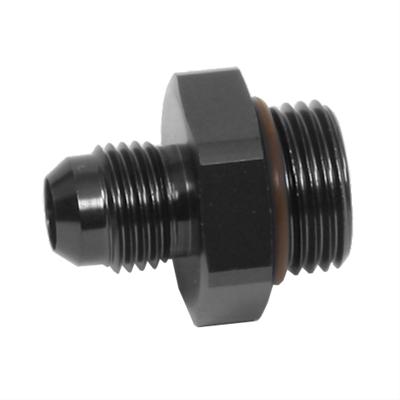

This. Or some variant of this.Looks like they are -8 O-Ring Boss in the cooler itself, so can easily adapt up or down depending on what you need. Since most cooler systems are plumbed in 3/8" tubing or hose, and assuming that supplied hose barbs aren't acceptable (they never should be) then a -6AN X -8ORB adapter fitting will allow the use of any type of AN style hose end or tube nuts that might be preferred.
Summit House Brand -6AN X -8ORB Adapter fitting:

6r80 and other later model trans REQUIRE an -8AN size fitting minimum. If you doubt, do you think the OE manufacturers would spend ANY extra money on over sizing lines, coolers, etc if they didn't need to? Course not- Corporations won't spend an extra nickel if they didn't need to.Every situation is a little different, opinions will vary. I am in the maximum cooling camp, i would add a cooler and capacity if possible. I don’t think is such a thing as too cool for a transmission. Excessive heat hurts them, that said there are several options to keep the operating temps in check.
Quote from TS: (TS agrees that OE won't spend an extra penny more than they need to...)
"...radiator in the higher latitudes, just that it will take longer for the trans to warm up. Which will have wear consequences. The singular thing that I keep in mind when deviating from an OEM system or lay-out is that while an Engineer designed it, a Costing Accountant approved it. That means that the system was designed to be the least expensive system that would work for at least for the warranty period no matter where the vehicle ended up.
Adding the t-stat to a non-radiator cooler system will speed up warming the trans to operating temperature, but not as fast as with the radiator in the system where it is actively heating the ATF during a cold start. I'd rather have the radiator in the system with a t-stat on the aux cooler so that during a cold start the trans comes up to temp with the engine, and then the aux cooler can make sure that the ATF doesn't get any warmer."
Winter temps won't allow the trans to get up to 75deg temp w/o some sort of valve/sensor to hold fluid back or else it will circulate and cool... think of oil in an engine... don't we let car engines warm up enough to make sure the oil warms up properly so it can circulate well? Why would trans oil be different is all I"m saying.
Last edited:

Broncobowsher
Total hack
- Joined
- Jun 4, 2002
- Messages
- 37,067
I'm trying to remember the transmission, or even the make. But I remember seeing an automatic transmission that had what looked like an extra oil cooler on it. But it already had the traditional cooler circuits (radiator + oil to air) up front. Looked it up, it is a transmission fluid heater. That was the official name of the extra heat exchanger on the transmission.
ntsqd
heratic car camper
Our '96 Cummins-Dodge has a liquid to liquid heat exchanger on the right side of the block that the trans cooler line goes to first. Can't recall if there is also one in the radiator, but it does also have a liquid to air "aux" cooler in front of the A/C condenser.
Related, but not directly important: My '88 V6/auto 4runner had a transfer-case liquid to air cooler tucked under the truck near the bell-housing on the right side. It appeared to function only when in 4WD because the pump was driven off the backside of the front output shaft.
Related, but not directly important: My '88 V6/auto 4runner had a transfer-case liquid to air cooler tucked under the truck near the bell-housing on the right side. It appeared to function only when in 4WD because the pump was driven off the backside of the front output shaft.
Broncobowsher
Total hack
- Joined
- Jun 4, 2002
- Messages
- 37,067
Did the 4Runner have lockout hubs or axle disconnect?Our '96 Cummins-Dodge has a liquid to liquid heat exchanger on the right side of the block that the trans cooler line goes to first. Can't recall if there is also one in the radiator, but it does also have a liquid to air "aux" cooler in front of the A/C condenser.
Related, but not directly important: My '88 V6/auto 4runner had a transfer-case liquid to air cooler tucked under the truck near the bell-housing on the right side. It appeared to function only when in 4WD because the pump was driven off the backside of the front output shaft.
I added a transmission cooler to the 6-speed MANUAL in my Xterra. Isspro gauge with add on relay module programmed to run an electric diff cooler pump through a stock ATF cooler. I like to see the gear oil in the trans up around 200, but didn't like seeing the oil pushing 250 when cruising at 80 for an hour in overdrive.
I remember talking with a Paccar thermal engineer one evening in Laughlin, NV. One of the conversation pieces was dealing with transmission temperatures. One of the overlooked parts, the bellhousing connecting the engine to the transmission. It is a thermal conductor. Heat will flow though the bellhousing (slowly) and can put heat into the transmission case, or pull it out and put it in the engine's water jacket. Suddenly I started thinking of where an aluminum bellhousing could be beneficial over an iron one. I have had a LOT of interesting conversations with engineers over the years and learned a lot of things that are interesting, in a nerdy engineering geeky type of way.
pbwcr
Sr. Member
- Joined
- Jul 11, 2007
- Messages
- 652
Note: While the Explorer serpentine system uses a reverse-rotation water pump (the pump pulley spins counter-clockwise due to the routing of the belt), the internal engine coolant flow relative to the radiator does not reverse—hot coolant goes out to the top radiator hose, and cool fluid enters through the bottom hose.I’m running the derale cooler https://a.co/d/0hixzItp in the original location of the battery. I have the fan wired to pull cooler air from the bottom of the inner fender up through the cooler. My temp gauge is mounted in the 4r pan. I’m seeing high temps around 160ish here in south Alabama. I want to get them down to around 150 but mainly looking to
Have the radiator fan helping cool the fluid while at a stop so I was thinking of running the fluid through the radiator first then the atomic cooler and back to the 4r70. However I also have the reverse flow rad for my explorer motor. So will it even be worth trying to get my temps lower than 160 if the fluid is going into the hot side of the radiator first?? I hadn’t even considered this until I saw your response.
ntsqd
heratic car camper
Manual hubs when I got it, and they were Aisin's so unlikely to have been converted as none of the PO's appeared to be enthusiasts.Did the 4Runner have lockout hubs or axle disconnect?
I have pondered one of the passive radiant trans coolers that fits into a PTO port for the NV4500.
Those are the best kind!....in a nerdy engineering geeky type of way.
@pbwcr: I believe what @widowmaker77 is referring to is that some of the radiators out there, because of how they have the hose bibs installed, have the trans cooler in the hot tank, not the cool tank of the radiator. That this was out there was news to me.
pbwcr
Sr. Member
- Joined
- Jul 11, 2007
- Messages
- 652
I did not know about radiators with trans cooler in hot side. I wonder about the theory of that? I guess for really cold environment like the artic?Manual hubs when I got it, and they were Aisin's so unlikely to have been converted as none of the PO's appeared to be enthusiasts.
I have pondered one of the passive radiant trans coolers that fits into a PTO port for the NV4500.
Those are the best kind!
@pbwcr: I believe what @widowmaker77 is referring to is that some of the radiators out there, because of how they have the hose bibs installed, have the trans cooler in the hot tank, not the cool tank of the radiator. That this was out there was news to me.
ntsqd
heratic car camper
I didn't either, it seems rather odd to me to do that. The explanation that I read was that there isn't room for the cold tank to have the HE in it, and that the in and out had been swapped side to side for ease of coolant plumbing. Seems like a half-arsed solution to a not huge problem to me, but fabricating SS tube coolant plumbing isn't in everyone's wheelhouse.

I've always used Allison Transmission for the benchmark for temps, they prefer 160-190, with the nominal preference being 165-170. Their transmissions have been known for their robustness for decades and the ability to go hundreds of thousands of miles at very high GVW's and power inputs. They have been used in the largest heavy haul trucks since before I was in diapers.
Been pondering a cooler for the G56 my tow pig has in it. Need to carry a temp gun and see where its temps run, for its duty requirements it does hold a lot of fluid at just over 6qt of ATF+4 and is aluminum cased. It will have to be over 200 degrees before I will consider it since there will need to be a pump added. I did clean all of the clay off of it, that has to help LOL.
Been pondering a cooler for the G56 my tow pig has in it. Need to carry a temp gun and see where its temps run, for its duty requirements it does hold a lot of fluid at just over 6qt of ATF+4 and is aluminum cased. It will have to be over 200 degrees before I will consider it since there will need to be a pump added. I did clean all of the clay off of it, that has to help LOL.
ntsqd
heratic car camper
This type of cooler is what I had been thinking to use on the NV in the Bronc-up:

'05-'18 Dodge Cummins Diesel Trans-Cool G56 Trans Cooler
The TRANS-COOL's fin cooling system is uniquely designed to transmit heat from the inner fins to the outer fins which helps dissipate heat.
www.genosgarage.com
- Joined
- Oct 11, 2007
- Messages
- 564
That is correct but the rad I’m running has the outlet and inlets reversed from the original rad. So the fittings for the transmission lines are still on the same side of the radiator as original but that side is now the hot side. The driver side tank is the cold side. This is what I run. https://tomsoffroad.com/products/66-77-ford-bronco-reverse-outlet-3-core-aluminum-radiatorNote: While the Explorer serpentine system uses a reverse-rotation water pump (the pump pulley spins counter-clockwise due to the routing of the belt), the internal engine coolant flow relative to the radiator does not reverse—hot coolant goes out to the top radiator hose, and cool fluid enters through the bottom hose.
Broncobowsher
Total hack
- Joined
- Jun 4, 2002
- Messages
- 37,067
My understanding is they line up with the factory cooler lines. When they did the reverse flow radiator, all the did was as little as possible. The didn't swap the tanks, or the cooler. All they did was put the radiator hose fittings on the other tank and called it a day. It wasn't engineered that way, wasn't engineered to have the trans cooler on the hot side. It just got that way out of making the radiator with as little change to tooling as possible. Quickest, laziest, but still works way of doing it. It is for engine cooling, be happy they put any transmission cooler in at atll. And the ports are in the stock location, so it hooks up like stock. It is some sort of cooler, they never said the transmission cooler was optimized.I didn't either, it seems rather odd to me to do that. The explanation that I read was that there isn't room for the cold tank to have the HE in it, and that the in and out had been swapped side to side for ease of coolant plumbing. Seems like a half-arsed solution to a not huge problem to me, but fabricating SS tube coolant plumbing isn't in everyone's wheelhouse.
Similar threads

- Replies
- 1
- Views
- 574

- Replies
- 3
- Views
- 2K
- Locked
City: Madera
Price: $3000
- Replies
- 17
- Views
- 4K