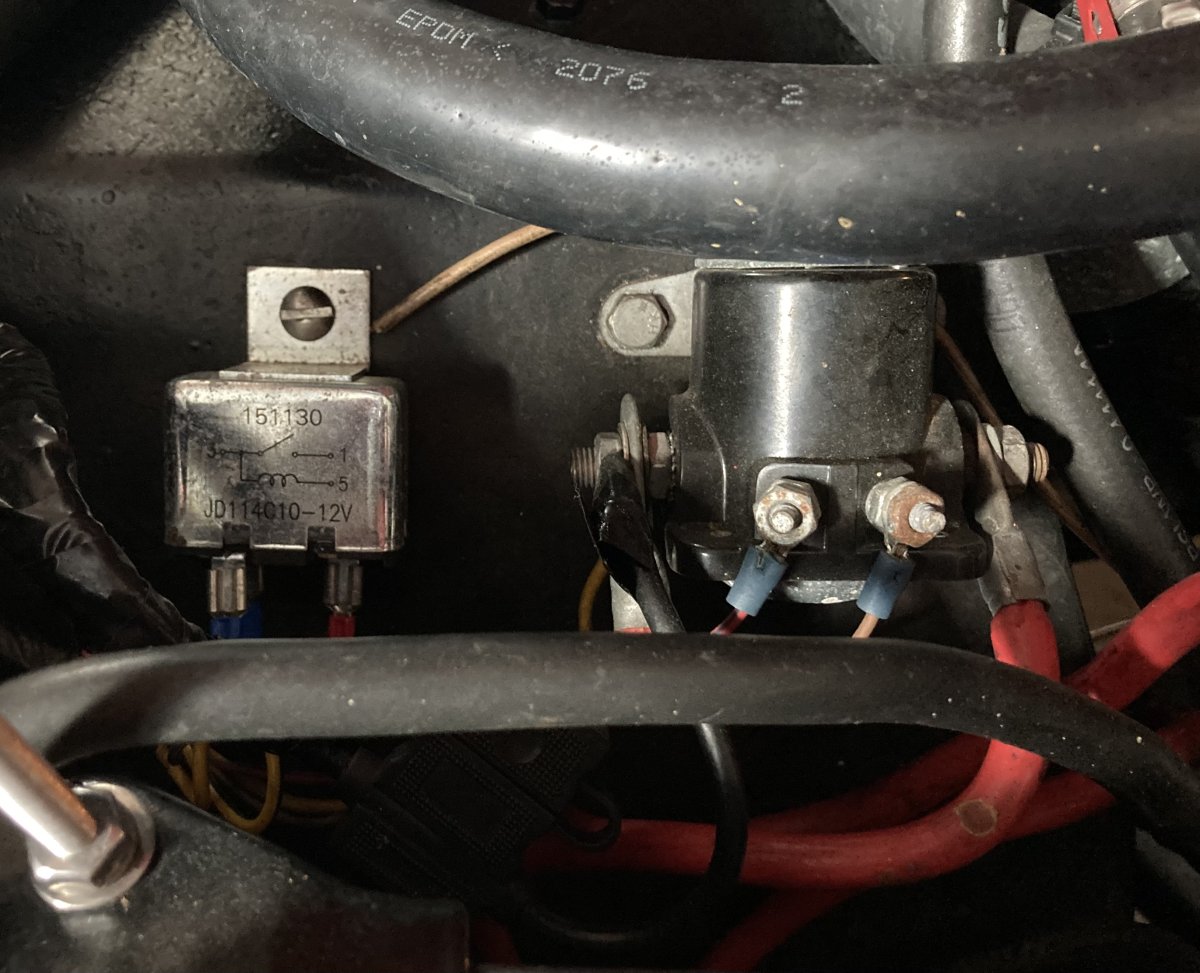
As I understand it, a relay closes an electrical contact only. Electromechanical in our case.
Doing no physical labor other than that.
I think there are some purely electronic relays around, but I have no familiarity with them.
A solenoid actually does physical labor by moving some mechanical parts. That’s why the piggyback cylinder thingy on a starter is a solenoid.
It is an electrical contact switch, possibly even called a relay, but because it moves a lever arm that shoves the drive gear into the engagement mode, it becomes a solenoid.
Ford always listed the fender mounted device as a “starter relay“ in their diagrams and texts.
Back in the day, many, or maybe most of the aftermarket manufacturers, listed it as a “switch“ on the box label.
Another term apparently used a lot in Canada is “mag switch“ or “magnetic switch“.
There is also, another term that I have seen used on box labels over the years and now I can’t remember what it is exactly. But I believe it had its roots in either Latin or French.
Maybe it was “connecteur” or something similar?
Since most people over the years have called it a solenoid, I believe most of the aftermarket parts manufactures, including Motorcraft, now list it as a solenoid on the label.
Doesn’t change the definition of the device, just means that they’ve caved in to popular lore.
At the same time some of our original Bendix type starters were made (which don’t have a solenoid) Ford also made solenoid type starters.
You might find those on a 460 equipped vehicle, whereas they continued to use the Bendix design on our 302s until sometime in the 80s when they switched over to what we call a mini starter, but Ford calls a PMGR starter with the piggyback solenoid.
Similar in design to the starters that most people are familiar with who ever owned a GM vehicle. They used solenoid starters, practically forever as far as my lifetime is concerned.
I’m pretty sure everybody started calling these things on the fender, a starter solenoid, because they didn’t know any different.
I think most people, even today, didn’t even know what a relay was. And since it had something to do with engaging a starter, it must be a solenoid!
Besides, apparently aftermarket companies in the early days, only knew General Motors products and didn’t really take the time to note the differences in Fords.
One of the reasons we get locking hubs from Warn and others that fit right on a GM vehicle and allow you to reuse the snap rings, where the snap rings usually won’t fit on a Ford.
Test on a Chevy, and don’t bother to note the few thousandths difference on a Ford. But sell it as a universal fit for Ford, Chevy and Dodge.
The word switch is correct, because a relay is simply a remotely controlled switch.
You do the manual work with the ignition switch on the dash, and the relay switches on the starter as a result.
Takes the majority of the load off of the light duty ignition switch and puts it on a heavy duty remote switch/relay.
This is just my hack's eye view of things. There are members here, who are far more versed in actual electric and mechanical and magnetic theory, and workings.
So hopefully they will correct any misinformation I might have put forth.
And some are even older than I am(!) and might have a different take on why they started being called solenoids.
Maybe because the electromechanical switch was such a robust item that they decided to call it a solenoid because it does the manual labor of closing the contacts.
Don’t know, but it’s still a relay.