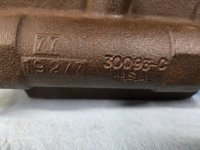
I've never bothered to look at casting information on any part I've installed. Just the fact that something fits, or doesn't fit, works or doesn't work, was all that concerned me in the past.
So I can't tell what the numbers on yours mean, but I can tell you two things.
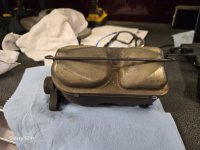
One is that it looks just like a standard Ford later model (such as '76 and '77 power setup) unit. The 4-wheel drum setups looked the same, but without the angle of the booster, the ports were on the left side. Yours with the ports on the right side would have been for a booster setup. At least on a Bronco. The larger piston size makes me think it's for a different vehicle. Unless some Broncos got the larger piston, I thought (but don't know) that all EB's got the 1" bore, whether manual drums or power disc setups.
And two, is that since it was made in the USA, it's a keeper!
Whether in as-is condition, or after a simple rebuild, I'd at least be considering keeping it, cleaning it up, maybe give it a quickie hone job (but only if needed) and re-use it.
Only if some damage makes using it problematic would I toss it out or use it as a core.
The earliest masters were single reservoir of course. Starting in about '66 or so, the disc brake cars got a slightly elongated dual-reservoir master, with two equal size reservoirs and rounded ends. Those were found on dual/tandem masters on '68 and maybe '69 Broncos with 4-wheel drums, making me think that, even though they revolved around disc/drum setups originally, Ford found the economy in using them for both drum and disc equipped vehicles. Sometime in either '69 or '70, Ford changed to the style like yours, with the two distinctly different sized reservoirs, with one square end and one rounded end. I've seen them with the large reservoir to the rear (most of them by far) and some to the front. No idea what dictated the different orientation.
My '71 came with the style like yours, but with the ports on the driver's side.
Paul