I seem to have a ground problem. When turn on lights, turn signals, flashers or apply my brakes my amp gauge shows discharging. When idling it sets on "0". When I rev the motor it goes up to approximately 12-14. When it goes back to idle its back on "0". New alternator, battery and regulator. All wired correctly. Tested them all and they all passed all test. What next?







Community
Buy / Sell



Bronco Tech
Fuel Tank Access Plate
3 Arm Wiper Setup
Fix Motor Mount
Roll Cage Braces
Throttle Body 65mm
Wheel Alignment
Heat Riser Replacement
Vent Window Repair
Center Console Mount
Straighten Bumper
Ford 6R80 6 spd
More Tech...
3 Arm Wiper Setup
Fix Motor Mount
Roll Cage Braces
Throttle Body 65mm
Wheel Alignment
Heat Riser Replacement
Vent Window Repair
Center Console Mount
Straighten Bumper
Ford 6R80 6 spd
More Tech...

-
Welcome to ClassicBroncos! - You are currently viewing the forums as a GUEST. To take advantage of all the site features, please take a moment to register. It's fast, simple and absolutely free. So please join our community today!If you have problems registering or can't log into your account, please contact Admin.
You are using an out of date browser. It may not display this or other websites correctly.
You should upgrade or use an alternative browser.
You should upgrade or use an alternative browser.
More electrical issues
- Thread starter Donabbo
- Start date

75MIKE
Sr. Member
You didn't say if you are still running the OEM alternator and regulator, but everything sounds about right if you are. What's it doing that you don't think it should?

Broncobowsher
Total hack
- Joined
- Jun 4, 2002
- Messages
- 37,059
Depending on how I read your statement, it is working correctly.

Hi, as long as the amp gauge shows + (charging), with lights and heater on, while driving, you should be good. As long as you are in the + side you are not running off the battery.
If you are cruising and the gauge shows - (discharge), you are draining the battery, and you have a problem.
Good luck
If you are cruising and the gauge shows - (discharge), you are draining the battery, and you have a problem.
Good luck
75MIKE
Sr. Member
Yep, That's it. Why many owners go to hi output alternators the have some "umph" even at idle.

^^^^that. And for piece of mind you could have it checked (local service station with service bays?? )while you wait takes a minute or two,,,,they can check voltage and amp output with load /no load/at idle and at higher rpm ,,,in vehicle testing is real world testing..

- Joined
- Nov 3, 2003
- Messages
- 51,613
When idling it sets on "0".
When it goes back to idle its back on "0".
Idling with lights on it shows discharging.
So the firs tests were with lights OFF?
For the most part, your readings are correct. But they're low under some other conditions. Perhaps...
Depends on how long the engine has been running and the alternator re-charging the battery.
The low charge at idle is common with the old alternators, but you should still be able to run lights without discharging. It's possible that your ammeter is reading incorrectly though too, after 50 years or so.
Next time you've got the hood up with a volt-meter in your hand, check the battery voltage and compare to the amp readings on the dash.
Any time you see a slight charge on the ammeter, your voltage reading should theoretically be over 13v at the battery.
Any time you see a big charge (say 15a or more) you should see more like 14.5v at the battery.
When it's at zero charge on the gauge, I'm not really sure how low the voltage will read, but likely somewhere between 12.5 and 13v or so.
Anytime it's discharging, or showing negative on the ammeter, you should see 12.5 or less at the battery.
But this whole charge/discharge thing depends on the charge of the battery.
Immediately after starting the engine you should see 30-40 amps on the ammeter. Then it should slowly go back down to just near zero.
The longer you run the engine and the more fully charged the battery becomes, your amp readings will be progressively less and less as the battery gets closer and closer to being fully charged.
The low to no charge at idle is a problem, but if it happens all the time and can't keep up with turning lights on and stuff, it just means that your particular alternator is weaker than it should be.
If that alternator does not bring the charge back up when you rev the engine, then the wiring or the alternator is just not up to the task. That's when people upgrade to larger, more powerful alternators.
The "small-case" 1G (original style) was well known for having a low output at idle speeds. The "large-case" version was much better. And the newer 3G is much better at idle too, and no longer has the external regulator wiring to deal with. Which is why it's the most popular upgrade.
But you should check your wiring anyway.
1. Battery cables should be new-ish and of 4ga or larger size.
2. Yellow wire at the regulator should read exactly battery voltage. If it's notably less than battery readings there is something wrong with the wire and/or it's connections.
3. The Green w/red wire should be close to battery voltage, but a little drop is not a big deal. And it sounds like yours is working anyway, but best to check. If it's too low it might be turning off the regulator at low engine speeds.
4. Check resistance on the Orange wire to make sure there is no miscommunication between the regulator and the alternator.
5. Verify that there is still a ground wire between the alternator case and the regulator case. They often get left out after a re-wire.
6. And finally, verify that you still have a body ground from the battery to the fender or wheel well. These almost always get left out when someone changes the original negative battery cables.
If none of this helps get you a better charging scenario, upgrade your alternator anyway. Yours may "pass the test" but it might still be weak.
Paul
- Joined
- Nov 3, 2003
- Messages
- 51,613
And speaking of real-world testing... Next time you're running the engine, turn all the accessories on again just like you did before, but this time rev up the engine.
If revving the engine does not show 14v or more, or you see a discharge on your ammeter, you need to upgrade the alternator to one with a higher output, or find out what's going on with the existing one.
Do you know what it's rated output is? What about during testing? Did they test total amperage output by any chance?
By "passing" it may only have had 40a output and maybe for them that was a pass. But if it's a 65a alternator and only capable of putting out 40 or 50 amps, then it's not functioning properly to begin with.
Any alternator should be able to output it's rated amps or more.
Paul
Broncobowsher
Total hack
- Joined
- Jun 4, 2002
- Messages
- 37,059
If you have anything hooked directly to the battery (headlight relays for example) that can throw off the amp meter reading.
The meter will be reading the power of the headlights. The voltage regulator will be stable, the alternator will be providing amperage to run the lights. Since the lights are connected directly to the battery the meter will read the amperage the lights draw. Saw it is 10A the charging system will be making 10A to power the lights. The battery being fully charged will be taking nothing. But the lights will be pulling 10A through the amp meter as if the battery was taking the 10A. The wiring is providing the 10A to the battery, but it is diverted at the terminals to the lights.
The opposite is also true. with the engine off you can turn on the lights. There will be the draw of the other lights and relay power but the actual lights connected directly to the battery will not read on the amp meter as you are bypassing it taking the amps directly from the battery. The starter does this as well. That huge multi-hundred amp load does not go through the amp meter, but the recharge does.
Hi, again, if the major concern is why the amp gauge is bouncing all around you can just add a volt gauge and see if you get @ 13.5 volts all the time. That is where you want to be. Good luck

- Joined
- Dec 12, 2017
- Messages
- 405
I would agree with B RON CO if you just use a voltmeter to check the battery while running you can tell if your battery is charging.
While installing my Centech wire harness it is set up to show the charging state of the battery minus the load of the electrical system. Thus if your electrical system (lights, flashers, radio, etc) is more than the alt is putting out it will show near zero or 0 amps.
I am sure the stock alt and charging system work in the same way
Chris
charlie6976
Sr. Member
If going volt meter, you might look at the digital read out type with phone charger and fits in a cigarette lighter hole or bracket. Would use same wiring/connection.
Stock alternator from EB era is weak at idle. Upgrade or you could try LED lights.
https://www.amazon.com/Charger-Higo...=digital+voltmeter+car&qid=1575380868&sr=8-18
Stock alternator from EB era is weak at idle. Upgrade or you could try LED lights.
https://www.amazon.com/Charger-Higo...=digital+voltmeter+car&qid=1575380868&sr=8-18
Last edited:

Comemonday71
Jr. Member
- Joined
- Jun 19, 2019
- Messages
- 138
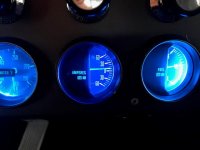
Hi gang! Don't mean to hijack! But got a question regarding this issue. Reading DirtDonk's comments at start up amp meter should show 30-40 amps and then should slowly go back down to just near zero. This is exactly what my amp meter does. I have included a picture of what my amp meter shows with lights on. Is this ok? Besides blowing a fuse for the turn signals I have never had any electrical issues...…..yet! Thanks
Attachments
- Joined
- Nov 3, 2003
- Messages
- 51,613
It does not indicate any trouble to me. At least initially...
And different types of ammeters will read differently as well, to a certain extent. Yours is not stock, so I don't know how it's connected, but that can have an effect too.
Also effects just how safe it is!
What you're watching is that during the engine start, the starter motor takes a lot of juice to crank the engine. Depending on the starter, engine, and overall electrical system, this could be a lot, or a little. As much as 250 amps for several seconds, or as little as 50-75amps for just a flash. The more energy it takes to start, the more the battery is depleted (for lack of a better term) and the alternator is tasked to build the battery back up from farther down.
That's when you see a large amp charge on your ammeter. If your engine snapps to life with little effort, you might only see a 15-20 amp charge for a short time.
Also depends on the state of the battery. If the battery is old and tired for example, the ammeter might show a charge for a longer period of time. Or shorter, depending on the battery's ability to take that charge. Could conceivably take 15 or 20 minutes for the needle to come back down to it's normal maintain level.
On the other hand, if it's a good battery and was fully charged to begin with, you might watch the needle climb back down to near zero in less than a minute or three.
If the needle takes a long time to drop, or if it goes way up and stays there (say for example, 20a or more for extended periods of time) then that could indicate a charge system error or a battery fault.
If it only reads that high when you have accessories powered up however, it would simply indicate to me that it's wired a little differently than stock.
That's why for me an ammeter is a great window on the electrical system. I have always preferred BOTH a volt-meter and amp-meter myself. If given only one choice, I might have trouble deciding which one I like better, but would likely choose the ammeter when it came right down to it.
But a voltmeter is also a really good tool and simpler to interpret most of the time.
Whether yours should come all the way to zero, or stay up at 10a or so when some accessories are on is hard to say.
Does it go to exactly zero when everything is shut down? Where is it connected into the system?
It's probably just measuring the output of the alternator and not detecting the drain of the lights due to how the system is wired.
One thing you can double-check though, is when your ammeter reads in the positive/charge section, check the voltage of the battery. If it's 14-15 it's great. If it's 16-18 you have problems!
The blowing of the turn signal fuse could have been completely unrelated to the amount of charge.
If you still have the stock fuse panel with glass fuses, it's not a bad idea to remove the fuses, clean the contacts (and the fuses themselves) and then re-install them. This helps create a better path for the electricity to flow. It's a well known issue with old cars with glass fuses.
I do it once a year, but if you did it every three or four years you'd probably be fine. It's usually a very subtle degradation over time.
Paul
- Joined
- Nov 3, 2003
- Messages
- 51,613
Thinking about it, I bet that SW gauge is a shunted-type and is simply reading how much the alternator is putting out, but not catching the individual draw of each component.
If this is the case then as you turn other things on the ammeter needle should go up even further. Is this the case?
When you flip on the high-beams, then turn on the heater and emergency flashers, what kind of a reading do you get?
This can also be a neat little gauge of how your components are working. If you turn on the heater and it shows 10amps, it's in great shape. If it shows 40 amps you can tell your heater blower motor is struggling!
Curious what it reads with other accessories on.
Your headlights on low-beam would typically draw about 8a through the system. With the engine running the ignition takes maybe a couple more amps. This is pretty close to what your needle is reading, so it sounds like your instrument is pretty accurate.
But it's one way to test stuff.
Have fun!
Paul
Comemonday71
Jr. Member
- Joined
- Jun 19, 2019
- Messages
- 138
Good Evening Paul!
Say, thanks for the great response; I will do my homework and get back to you. Until then!
Say, thanks for the great response; I will do my homework and get back to you. Until then!
- Joined
- Nov 3, 2003
- Messages
- 51,613
Cool. Was thinking of hunting down some SW info or instructions sheets too, but have not had the time yet.
I remember some, such as VDO, would read directly (where the current passes through the gauge) with their lower power ammeters of between 40 and 60 amp capacities, but used a shunted type (where the gauge is sent a remotely taken sampling of the current passing through a wire) for their 100 and 120 amp models.
Maybe yours is a direct reading type after all, so I'm definitely curious.
Good looking gauges.
Paul


